Model Distillation: How One AI Learns by "Copying" Another (and Why It Sparked a US-China Fight)
How can a cheap AI model be almost as good as one that cost billions? Sometimes it learned by copying. Understand model distillation and the case that put the US and China on a collision course.
Have you ever wondered how a much cheaper AI model can be almost as good as one that cost billions to build? Sometimes the answer is simple: it learned by copying the other one. This has a technical name and is more common than you would think. It is called model distillation.
The analogy: the master and the apprentice
Imagine a brilliant chef who spent a lifetime learning to cook. You have no access to their recipes or their kitchen. But you can do one thing: order a thousand dishes, taste each one carefully, and train a simpler cook to reproduce those flavors. In the end, you have a cook who is not the chef, but nails 90% of the dishes at a fraction of the cost.
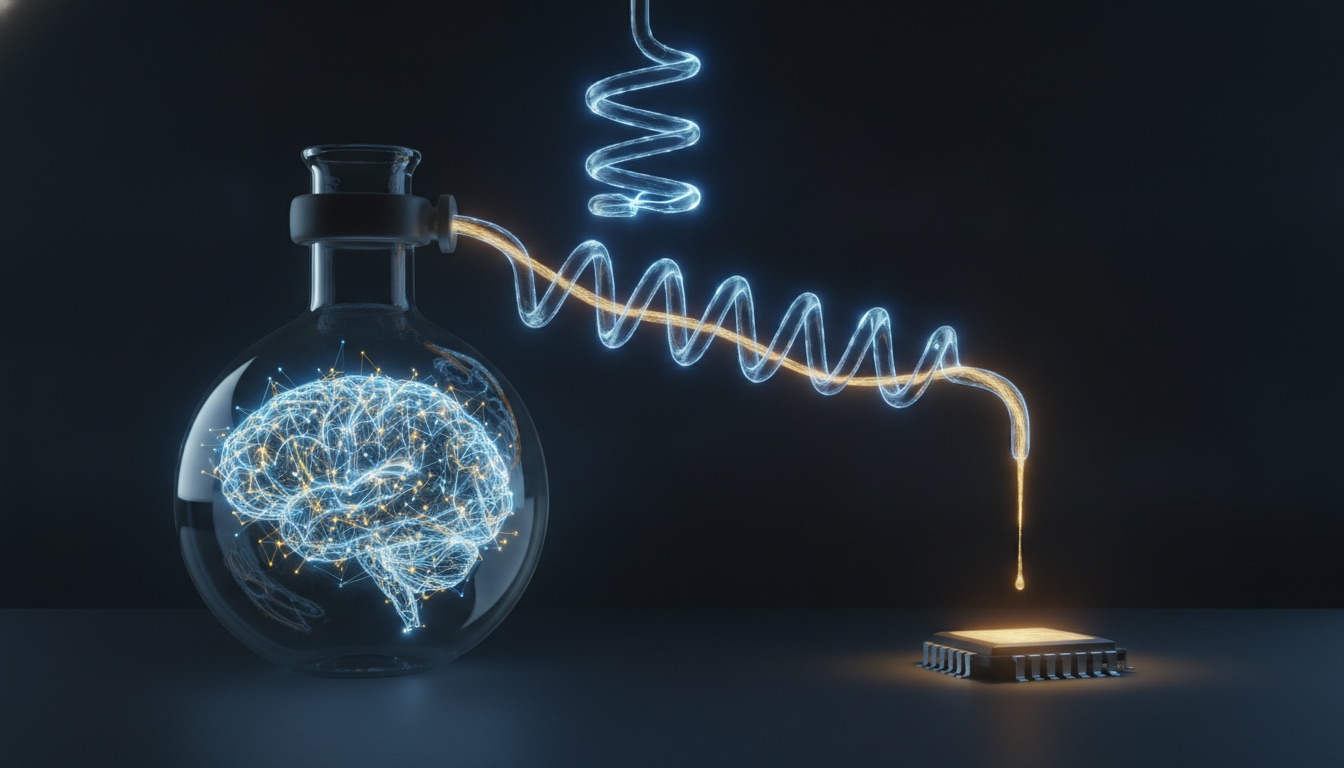
That is exactly what distillation does with AI. The big, expensive model (the "teacher") answers millions of questions. A smaller model (the "student") trains on those answers, learning to imitate the teacher's behavior. The result is a lighter, faster, and far cheaper model that approximates the quality of the original.
The detail that confuses many people: in distillation you do not steal the "recipe" (the training data, the model's internal weights). You only observe the answers and learn to reproduce them.
Not all distillation is villainy
A quick reality check: distillation is a legitimate technique that has been used for years in the industry. It is thanks to distillation that we have small models running on your phone, cheaper assistants, and fast versions of giant models. A company distilling its own model to get a leaner version is completely normal.
The problem starts when you distill someone else's model, without permission, at industrial scale, to cut corners and save the billions your competitor spent. At that point it stops being a technique and becomes, in the eyes of the copied party, copying someone else's homework.
The case that became a clash between superpowers
That is more or less what blew up in 2026. Anthropic, the American company behind Claude and frontier models like Mythos 5 (so advanced that the United States placed it under export controls), accused Chinese labs of distilling its models at scale.
The most cited case: in June 2026, in a letter to the U.S. Congress, Anthropic claimed that Alibaba's Qwen lab had allegedly created around 25,000 fake accounts over six weeks and harvested roughly 28.8 million conversations with Claude to train a rival model. Months earlier, similar accusations had been made against other Chinese labs, such as DeepSeek, Moonshot AI, and MiniMax.
The matter left the tech world and became a state affair: the White House weighed in, the U.S. tightened export controls, and China responded by unveiling its own tools, one of them nicknamed "China's version of Mythos".
Two honest points about this case: first, all of this consists of accusations by Anthropic and the U.S. government, not something tried and proven. Second, distillation in itself is not a crime. The controversy is about distilling someone else's model, en masse, bypassing the terms of use, and about what that means in a race where AI has become a matter of national security.
Why this matters to you
This topic seems distant, but it explains things you see every day. It is because of distillation that so many new, cheap, "almost as good" models appear every month. It is why training from scratch (spending fortunes) became a competitive advantage that companies want to protect at all costs. And it is why "copying" in the AI world is a slipperier problem than copying software: nobody has to steal the code, they just have to talk to the model a lot and learn from the answers.
Understanding these behind-the-scenes dynamics, how a model is trained, copied, distilled, and protected, is what separates those who merely use AI from those who truly understand the game being played. At Data Lover, that is what we teach: not just pushing the buttons of artificial intelligence, but seeing how it works on the inside and what is at stake.
In the end, distillation reveals a curious truth about our era: sometimes the most valuable asset is not the model itself, but the right to learn from it.
Sources
Frequently asked questions
It is training a smaller model using the answers of a larger model, so the small one imitates the big one's behavior at a much lower cost.