The AI Scissors: Why Average Wages Stall While AI-Skilled Pay Soars

Is AI reducing wages?
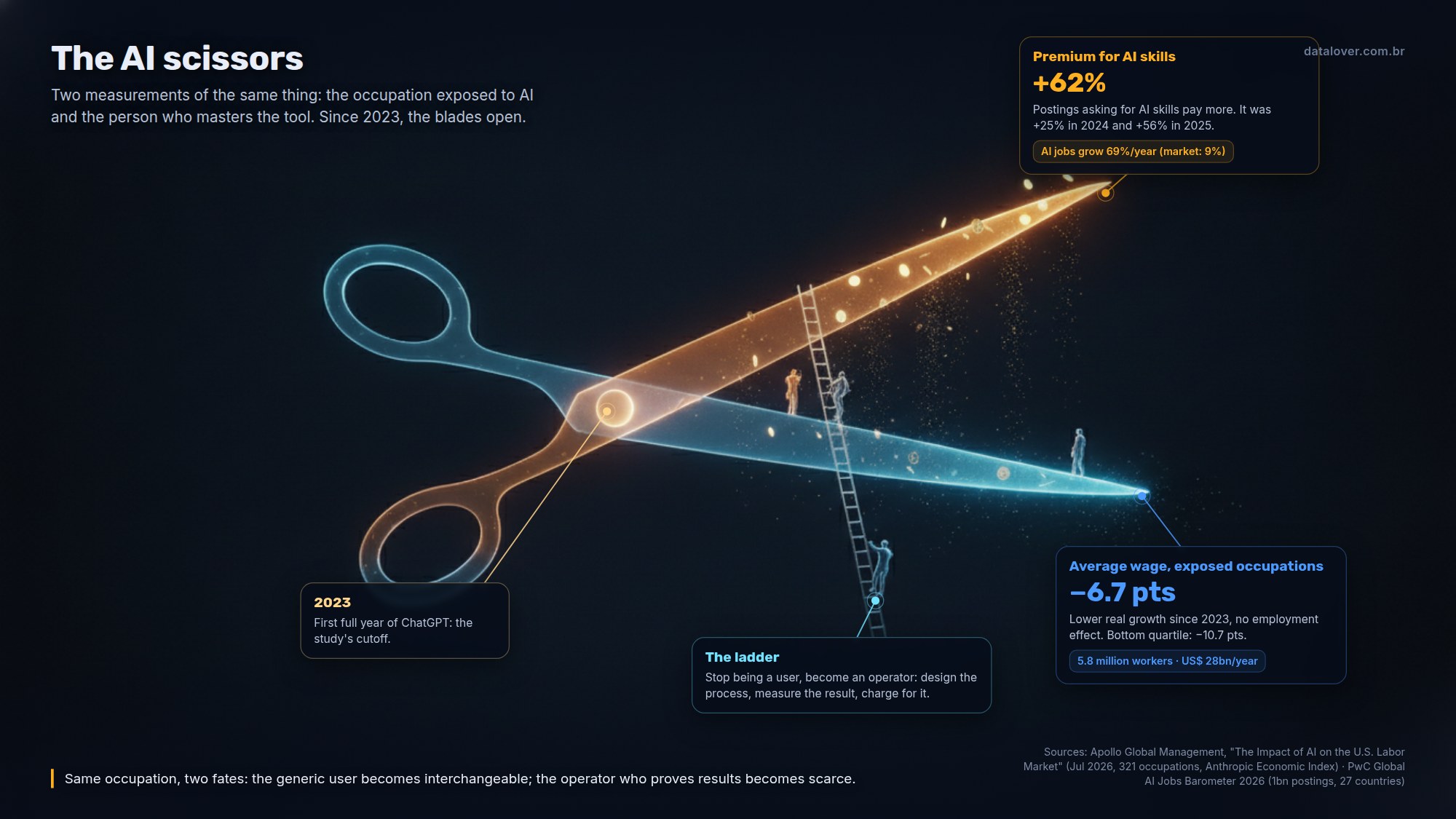
Not cutting, but slowing: the Apollo study (2026) shows that in occupations where AI already performs half the tasks, real wages grew 6.7 percentage points less since 2023, with no effect on employment. The bill falls on lower earners: the bottom quartile lost 10.7 points.
Two studies came out almost together and seem to contradict each other. The first, from asset manager Apollo, shows that in occupations where AI already performs half the tasks, wages have grown 6.7 points less since 2023. The second, from PwC, shows that job postings asking for AI skills pay 62% more. Both are right. They are just looking at different ends of the same pair of scissors: the average wage of those "exposed" to AI stops rising, while the pay of those who master AI soars. The question is no longer whether AI will touch your salary. It is which side of the scissors you will be on.
What the Apollo study found
The Apollo Global Management white paper (Sania Edlich and Torsten Sløk, July 2026) did something almost nobody had done: instead of estimating what AI could do in each occupation, it measured what it already does. The basis is the Anthropic Economic Index, which records which tasks of each occupation appear being performed with Claude. Crossing that with wages and employment for 321 US occupations between 2015 and 2025, with a break in 2023 (the first full year of ChatGPT), the authors reached three numbers:
- Wages: in high-exposure occupations (half or more of tasks already done with AI), real wages grew 6.7 percentage points less than elsewhere.
- Employment: no statistically relevant effect. On average, nobody was laid off by AI.
- Who pays the bill: the lowest wage quartile lost 10.7 points; service occupations, 24.3 (small sample, the authors warn); the top of the pyramid felt nothing.
Their conclusion in one sentence: firms are capturing AI productivity gains "through wage compression rather than workforce reduction". That is 5.8 million workers in those 11 occupations today, and about US$ 28 billion a year in income that stopped reaching pockets.
What the PwC study found
PwC's 2026 Global AI Jobs Barometer looked elsewhere: more than a billion job postings in 27 countries. And it found the apparent opposite: a posting that asks for AI skills pays on average 62% more. In 2025 it was 56%; in 2024, 25%. The premium is accelerating, not shrinking. Jobs requiring AI grow 69% a year, against 9% for the whole market. And the report speaks of "two futures": occupations where AI complements humans see twice the job growth and faster wage gains; occupations where AI lowers the entry barrier fall behind.
Why both are right at the same time
Apollo measures the occupation: what happens to the average wage of a job when AI starts doing half of it. PwC measures the person: how much more the market pays someone who proves they can use the tool. Put them together and the picture is sharp: inside the same exposed occupation, the market is splitting in two.
Most people "use AI" the way they use spell-check: the task gets done faster, the boss is pleased, and the value of that hour of work drops, because anyone with the same assistant does the same. That person became interchangeable, and interchangeable does not negotiate a raise. A minority does something else: masters the tool to the point of delivering what used to take three people, measures the result and charges for it. That person is scarce, and scarce is what gets the 62%.
Apollo's own study shows this between the lines. Among exposed occupations, programmers lost 17% of jobs and 6% of wages, but financial analysts gained 17% in jobs and marketing professionals, 8%. Outside the high-exposure group, data scientists grew 46% in employment. The difference is not the profession. It is whether AI replaces the whole task or amplifies the person doing it.
Our view
Three things we believe, and both studies confirm:
- Productivity gains are real, and someone always keeps them. Today, on average, the company does, because the generic AI user is easy to replace. It is not corporate malice; it is the market doing what markets do with what is abundant.
- The premium goes to operators, not users. A user asks AI to do something. An operator designs the process, connects tools, checks the output and answers for it. It is the difference between someone who "uses ChatGPT" and someone who builds a flow that solves the company's problem on its own.
- Those who earn less can least afford to wait. Compression hits the bottom quartile first, exactly where access to training is lowest. Waiting for AI to "settle" is the most expensive decision there is, and the lower the salary, the more expensive it gets.
How to land on the right side of the scissors
- Measure results, not tasks. "I used AI to write the report" is worth nothing. "I cut the closing cycle from five days to two, here is the spreadsheet" is worth a raise. Document before and after.
- Move toward the work AI amplifies. If your routine is typing, transcribing and filling in, AI is doing your job. If your routine is deciding, analyzing and persuading, it is making you more productive. Shift your week toward the second group.
- Prove it, by name. PwC's premium is for postings that ask for the skill by name: prompting, automation, agents, AI-driven analysis. Put what you did on your CV, with numbers, not "familiarity with AI tools".
Beyond the US
Both studies cover the rich world (Apollo, only the US). In emerging markets like Brazil, customer service, sales and back-office are huge and sit among the most exposed occupations; compression tends to arrive first where bargaining power is already low. On the other hand, the scarcity of people who truly operate AI is greater there, and scarcity pushes the premium up. The two blades are further apart in emerging markets, in both directions.
AI does not decide your salary. It decides the shape of the scissors. Which side you land on is still your choice, and the window to choose is open now, while most people still think "using AI" is the same as knowing how to use it.
Frequently asked questions
Not cutting, but slowing: the Apollo study (2026) shows that in occupations where AI already performs half the tasks, real wages grew 6.7 percentage points less since 2023, with no effect on employment. The bill falls on lower earners: the bottom quartile lost 10.7 points.
Yes. PwC's 2026 AI Jobs Barometer, covering over a billion job postings in 27 countries, shows that postings asking for AI skills pay on average 62% more (56% in 2025, 25% in 2024), and these jobs grow 69% a year versus 9% for the market.
Because they measure different things: Apollo measures the average wage of the AI-exposed occupation; PwC measures the premium paid to the person who proves AI skills. Inside the same occupation the market splits: the generic user becomes interchangeable and loses bargaining power, while those who master the tool become scarce and capture the premium.
By observed usage in the Anthropic Economic Index, 11 occupations have half or more of their tasks already done with AI: computer programmers (0.75), customer service representatives (0.70), data entry keyers (0.67), medical records specialists (0.67), market research and marketing specialists (0.65), medical transcriptionists (0.64), non-technical sales reps (0.63), database architects (0.58), financial analysts (0.57), software QA (0.52) and statistical assistants (0.51).
Measure results instead of tasks (document before and after in numbers), move your routine toward work AI amplifies (deciding, analyzing, persuading) rather than what it replaces (typing, transcribing, filling in), and prove the skill by name on your CV: prompts, automations, agents and AI-driven analysis, with concrete results.
Data and AI executive with 20+ years building technology that moves businesses. Microsoft Certified Trainer, with executive education at MIT Sloan. At Data Lover, he trains professionals and leads enterprise AI projects.
See profile and all articles →