Brazil Will Have One of the 10 Largest AI Supercomputers in the World. So What?
What did Brazil announce in artificial intelligence?
R$ 2.3 billion (about US$ 444 million) from the FNDCT fund in two projects: R$ 1 billion for a supercomputer in Rio Grande do Norte aiming at the world's top 10, with Nvidia as the expected supplier and operation by the end of 2027; and R$ 1.3 billion for infrastructure in Rio de Janeiro with Huawei and iFlytek, focused on language models, starting July 2027.
Last week the Brazilian government announced R$ 2.3 billion (about US$ 444 million) for artificial intelligence, with a headline promise: a supercomputer in Rio Grande do Norte that should rank among the 10 most powerful in the world. The news spread, comments split between "finally" and "what for", and few people answered the question that matters: what does this change for anyone who does not work in a lab? The honest answer is "a lot, but not tomorrow, and not the way the headline suggests". Let's go step by step.
What was announced, plainly
According to Al Jazeera and the Brazilian press, the package, funded by the national science and technology fund (FNDCT) and released in phases, has two blocks:
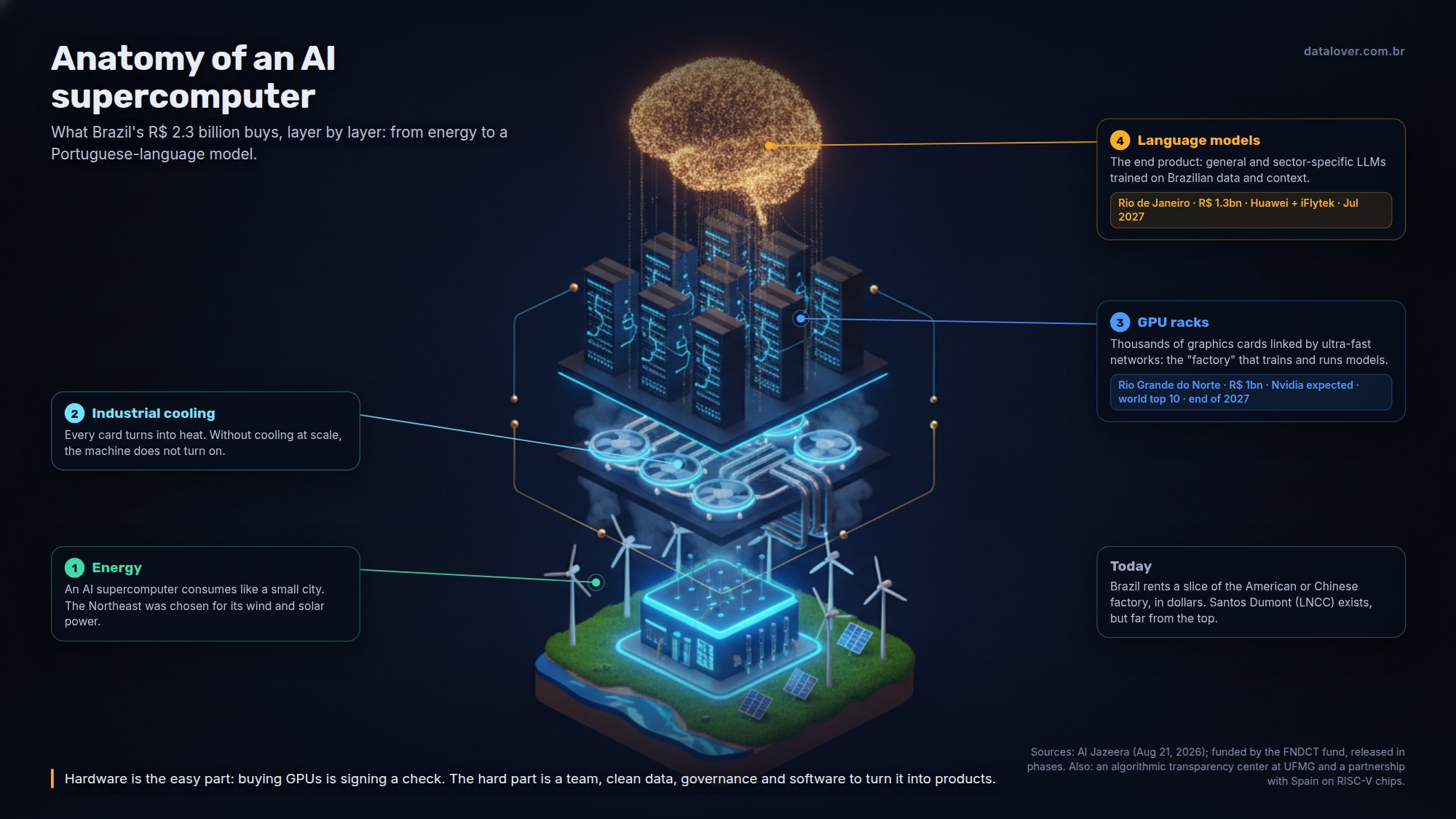
- R$ 1 billion for a supercomputer in Rio Grande do Norte. An open tender, with Nvidia as the expected supplier. Goal: enter the world's top 10 AI machines. Expected operation: end of 2027. The state was chosen for its energy potential (Brazil's Northeast produces a lot of wind and solar power, and an AI computer is, above all, an electricity bill).
- R$ 1.3 billion for infrastructure in Rio de Janeiro with Huawei and iFlytek. Focused on training general-purpose and sector-specific language models. Cooperation starts in July 2027.
There is also an algorithmic transparency center at the Federal University of Minas Gerais and a partnership with Spain on open-architecture chips (RISC-V). And an explicit political message: "the strategy is not to depend on a single company, technology or country". In plain words: one foot in the United States, the other in China.
What an AI supercomputer actually is
Forget the image of a giant computer that "thinks". An AI supercomputer is a warehouse with thousands of graphics cards (GPUs) linked by ultra-fast networks, industrial cooling and a power substation. It does two things: train models (teach an AI from scratch, which takes weeks of uninterrupted computation) and run models at scale (answer millions of requests). It is the factory; the ChatGPT you use is the product that came out of it.
Today, almost all of that factory sits on American or Chinese soil. When a Brazilian company uses AI, it rents a slice of one of those warehouses, in dollars, under the owner's rules. Brazil already has Santos Dumont, at the LNCC in Petrópolis, but it is far from the top and was designed for general science, not AI at scale.
Why a country wants its own
- Data sovereignty. Public health, tax, courts, social security: some data cannot (and should not) be processed on foreign servers. Without a machine of its own, a country either skips AI on that data or uses it at risk.
- Language and context. Models trained abroad speak good Portuguese but know Brazil poorly: laws, public health jargon, regional slang, government documents. Training models on Brazilian data requires compute at home.
- Cost and queue. Brazilian universities and startups compete for GPUs on the world market against Meta and OpenAI, and lose. A public supercomputer becomes a domestic queue for research and for companies without billions.
- People. Machines attract projects, projects attract researchers, researchers train students. No country became relevant in AI without somewhere to train models.
What changes for you (and when)
If you run a business: nothing changes in 2026. From 2028, the expectation is access to national compute through public calls and partnerships, and Portuguese models trained with Brazilian context, which should make AI cheaper and better for regulated sectors (health, finance, legal, government). Practical tip: organize your data now. A machine without clean data trains nothing.
If you are building a career: this is the best news in the announcement. People who operate, optimize and use AI infrastructure (data engineering, MLOps, modeling, model evaluation) will see demand from a side that did not exist: the public sector and national research. And those who know how to apply AI in business will have models better fitted to Brazil to work with.
The other side, no cheering
- Top 10 is a moving target. The world supercomputer ranking changes every six months, and the machine is ready at the end of 2027. Entering the top 10 in 2027 does not guarantee being there in 2029.
- Hardware is the easy part. Buying GPUs is signing a check. The hard part is a team to operate it, data to train on, governance to decide who uses it and software to turn computation into products. Brazil's history has expensive idle machines.
- Two legs, two risks. Depending on the US and China at the same time is a hedge, but also a double headache of sanctions, export licenses and technology compatibility.
- Energy. Choosing the Northeast is smart, but an AI supercomputer consumes like a small city. The bill must be in the project from day one.
So what, then? Brazil decided to stop being only a customer of the AI factory and own a piece of it. It is the right decision, with execution still to be proven. If it works, the result will not show up in the 2027 headline; it will show up in the Portuguese model your company uses in 2029 and in the job your student takes to keep it all running.
Frequently asked questions
R$ 2.3 billion (about US$ 444 million) from the FNDCT fund in two projects: R$ 1 billion for a supercomputer in Rio Grande do Norte aiming at the world's top 10, with Nvidia as the expected supplier and operation by the end of 2027; and R$ 1.3 billion for infrastructure in Rio de Janeiro with Huawei and iFlytek, focused on language models, starting July 2027.
A warehouse with thousands of graphics cards (GPUs) connected by ultra-fast networks, with industrial cooling and high energy demand. It is used to train AI models from scratch (weeks of continuous computation) and to run them at large scale. It is the factory from which products like ChatGPT come out.
For data sovereignty (sensitive public data should not be processed on foreign servers), for language and context (models trained on local data understand the country better), for cost and access (universities and startups cannot compete for GPUs on the world market) and to attract research and train people.
In the short term, nothing. From 2028, the expectation is access to national compute through public calls and Portuguese models with Brazilian context, useful for regulated sectors. For careers, demand grows for people who operate AI infrastructure (data engineering, MLOps, model evaluation) and for those who apply AI in business.
The top-10 ranking changes every six months and the machine is only ready at the end of 2027; hardware is the easy part, the hard part is team, data, governance and software; depending on the US and China at once doubles sanction and compatibility risks; and an AI supercomputer consumes as much energy as a small city.
Data and AI executive with 20+ years building technology that moves businesses. Microsoft Certified Trainer, with executive education at MIT Sloan. At Data Lover, he trains professionals and leads enterprise AI projects.
See profile and all articles →