Copilot, Chatbot, Agent, Assistant: What Is the Difference, Really?

What is the difference between a chatbot and an AI agent?
A chatbot answers questions within a closed scope, following scripts or prepared responses. An agent receives a goal and executes a sequence of steps on its own: querying systems, using tools and making intermediate decisions until it delivers the result.
You chat with ChatGPT, Word offers you a Copilot, your bank's site has a chatbot, and every tool ad now promises an "AI agent". The words sound interchangeable, and almost everyone uses them wrong. The difference between them is not marketing fluff: it is the difference between a tool that answers, one that suggests, and one that acts on its own. Knowing which is which changes what you should expect (and demand) from each.
Here are the four, from simplest to most autonomous, each with an example you have already lived.
Chatbot: the scripted attendant
The chatbot is the oldest of the bunch. It converses, but on rails: it recognizes the topic of your message and replies with what was prepared for that case. The bank bot offering "statement, balance or human agent", the store bot answering "where is my order": classic chatbots.
Newer ones use generative AI to sound natural, but the role is the same: resolving frequent questions within a closed scope. What it does not do: leave the scope. Ask the pizza chatbot about tomorrow's weather and it goes back to the menu.
Assistant: the on-demand generalist
The assistant is the ChatGPT, Claude or Gemini in your life. It talks about nearly anything, writes, summarizes, explains, translates. The key phrase is on demand: it responds to what you ask, one task at a time, then waits for the next request.
It is a brilliant intern on call: it does almost anything that fits in a conversation, but takes no initiative. If you do not ask, nothing happens. And without connections to your systems, it advises without executing.
Copilot: the specialist embedded in the tool
The copilot is an assistant that lives INSIDE a specific program and sees what you are doing there. Word's Copilot sees your document, Excel's sees your spreadsheet, the coding one sees your code. That is why its suggestions are contextual: "want me to summarize this section?", "this formula has an error".
The key word is suggest: the copilot proposes, you accept or decline. The name comes from aviation, and it is honest: you are still the pilot. An Excel copilot does not send email; an email copilot does not touch your spreadsheet. Each lives in its own tool.
Agent: the executor with a goal
The agent is the category jump. Instead of a question, it receives a goal, and breaks down the steps by itself: it queries systems, uses tools, decides the next move, and comes back with the result (or a question, if it gets stuck). "Analyze the overdue invoices, rank them by risk and draft the collection messages" is agent work: it involves fetching data, calculating, writing and organizing, in sequence, without you driving every step.
It is also where caution lives: acting alone requires limits. Good agent systems have human approval gates for critical steps: the AI prepares, you release. Autonomy without governance is not a feature, it is a risk.
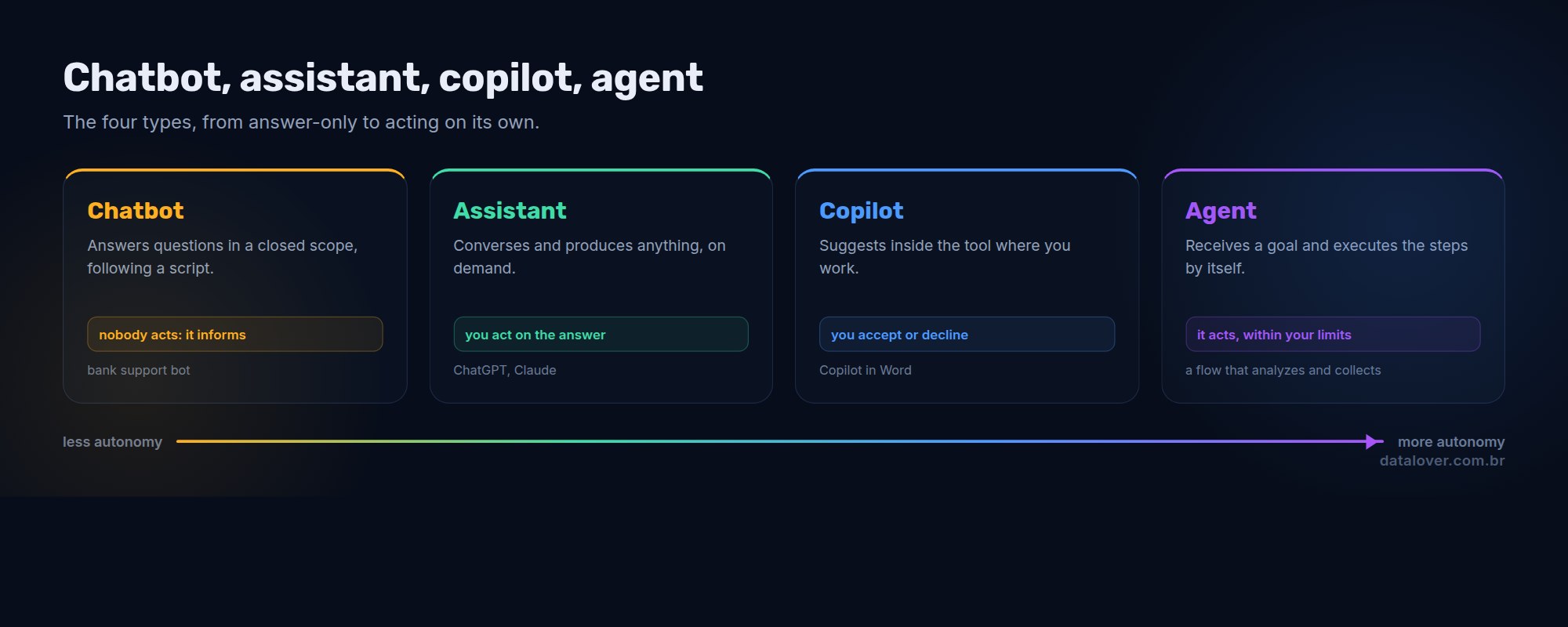
The table to pin on the wall
| What it does | Who acts | Example | |
|---|---|---|---|
| Chatbot | Answers questions in a closed scope | Nobody acts; it informs | Bank support bot |
| Assistant | Converses and produces on demand | You, with the answer in hand | ChatGPT, Claude |
| Copilot | Suggests inside a tool | You, accepting or declining | Copilot in Word |
| Agent | Receives a goal and executes steps | It does, within your limits and approvals | A flow that analyzes and collects from clients |
Why the labels mislead
Because "agent" became a marketing word. Many tools sold as agents are chatbots with a better script; many "copilots" are a generic chat with a new name. The test that never fails: in the end, who presses the button?
- If the tool only informs: chatbot.
- If it produces content you then use: assistant.
- If it suggests inside your workflow: copilot.
- If it executes a sequence of actions with real autonomy: agent.
That ruler also tells you what to demand from each. From a chatbot, solving common questions without irritating people. From an assistant, quality of output. From a copilot, suggestions that genuinely save time. From an agent, complete results and well-defined limits.
Next time a tool introduces itself with one of these names, you know the right question. And if the answer is "you press every button, always", fine: just do not let them sell you that as an agent.
Frequently asked questions
A chatbot answers questions within a closed scope, following scripts or prepared responses. An agent receives a goal and executes a sequence of steps on its own: querying systems, using tools and making intermediate decisions until it delivers the result.
An assistant embedded inside a specific tool (Word, Excel, a code editor) that sees the context of your work and makes suggestions. It proposes and you decide: control of the action stays with the user.
In ordinary conversation, no: it is an assistant that responds on demand. It acts as an agent when it gains tools and autonomy to execute steps by itself, such as browsing, using systems and completing multi-step goals.
Ask who executes the action in the end. If the tool only informs or suggests and you press every button, it is not an agent. If it receives a goal and completes steps autonomously (ideally with human approvals at critical points), it is.
It depends on governance. Good systems limit what the agent can access and require human approval for sensitive actions, like sending messages or moving money. Autonomy without defined limits is a risk, not a feature.
Data and AI executive with 20+ years building technology that moves businesses. Microsoft Certified Trainer, with executive education at MIT Sloan. At Data Lover, he trains professionals and leads enterprise AI projects.
See profile and all articles →