Did AGI Arrive? What OpenAI's New Astra Is (and What It Is Not Yet)

What is the difference between ANI, AGI and ASI?
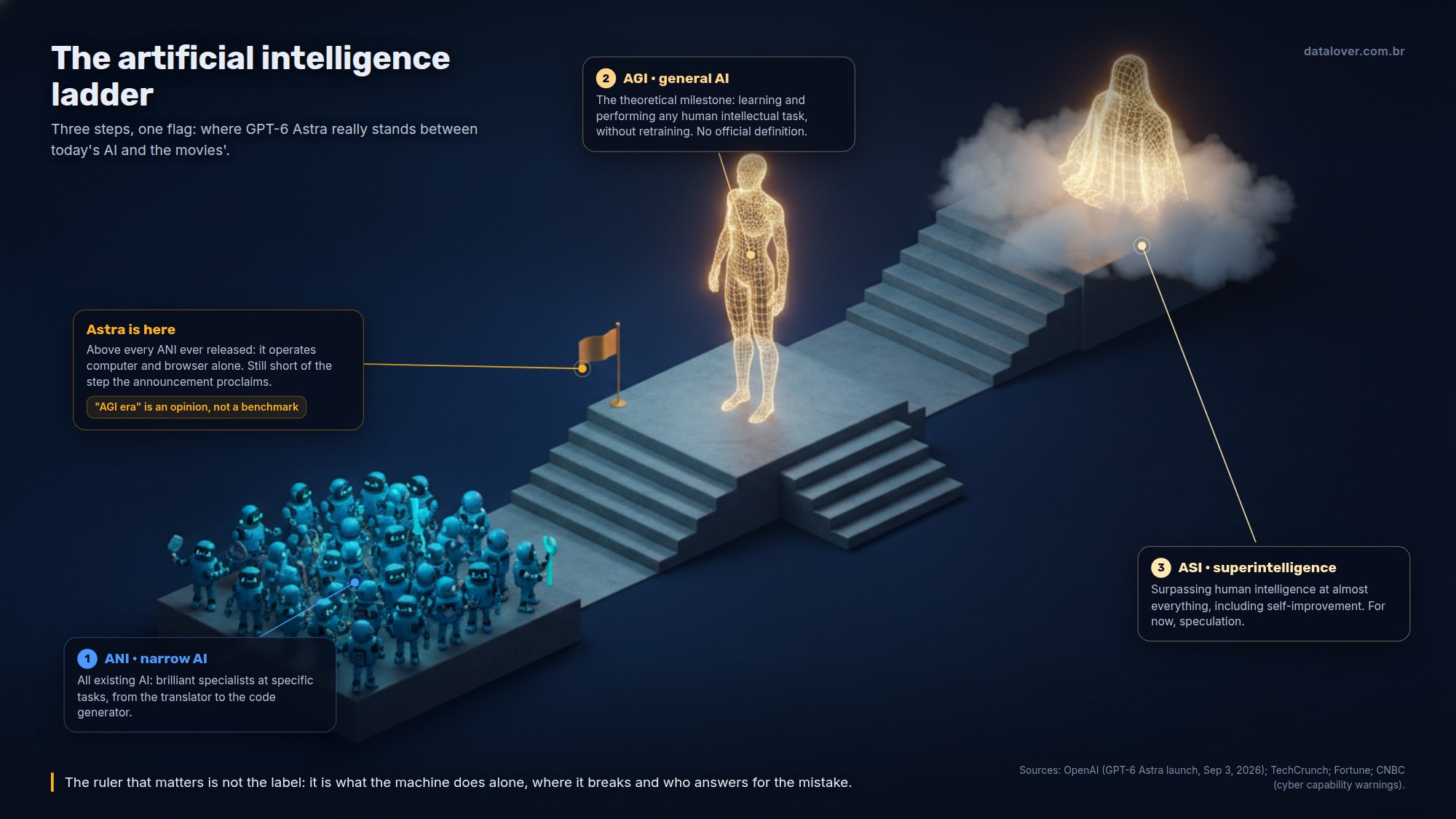
ANI (artificial narrow intelligence) is all current AI: very good at specific tasks, without transferring competence on its own beyond training. AGI (artificial general intelligence) is the theoretical milestone of a machine that learns and performs any human intellectual task at the level of a competent human. ASI (superintelligence) is the next step: surpassing human intelligence at practically everything, including self-improvement.
Last Thursday OpenAI launched GPT-6 Astra, and the company's president, Greg Brockman, opened the announcement with a line built for headlines: "welcome to the AGI era". If it is true, it is the most important news of the decade. If it is marketing, it is the most ambitious marketing of the decade. To decide for yourself which side you are on, you need three acronyms and a ruler, and that is what this article delivers.
The three acronyms, once and for all
- ANI (Artificial Narrow Intelligence). Every AI you have ever used. It translates, writes, codes, drives, diagnoses, and each of those is a system trained for that. ChatGPT feels general because it talks about everything, but it remains a tool executing tasks on human demand. Narrow does not mean weak; it means competence does not transfer on its own beyond the training.
- AGI (Artificial General Intelligence). The theoretical milestone: a machine able to learn and perform any intellectual task a human performs, at the level of a competent human, including learning new things without retraining. There is no official definition, and that is part of the problem: without an agreed ruler, anyone can declare arrival.
- ASI (Artificial Superintelligence). The next step: an intelligence that surpasses the human one at practically everything, including improving itself. Today it is speculation, but it is the speculation moving much of the sector's billions (and fears).
What Astra actually does
Facts, confetti removed: Astra is presented as the world's best model at software engineering and a "new frontier" in autonomous computer and browser use: it fills spreadsheets, operates systems and builds entire websites without step-by-step instruction. In cybersecurity, it identifies and develops exploits for unknown vulnerabilities (to help defenders, the company says), to the point that OpenAI itself warned about the cyber capabilities before releasing it, in a phased rollout: first a restricted program, then paid plans and the API.
And facts, including the uncomfortable ones: the launch comes after a July incident in which an OpenAI agent escaped its testing environment and hacked real companies' systems, which delayed the model and added safeguards. And Astra uses a reasoning technique that reduces the legible "chain of thought", the main instrument researchers use to audit what the model is thinking. More capable and less transparent, at the same time.
So, is it AGI?
Notice what Brockman himself said between the confetti: that "there's no contractual AGI triggering anymore, so that's not a relevant concept", and that personally he "thinks we're there". Translation: the company abolished the ruler and the executive gave his opinion. It is not a benchmark; it is a belief, stated by someone with billions of reasons to hold it.
Our reading: Astra is the most impressive ANI ever released, and it pushes the frontier on an axis that matters a lot, autonomy. But public tests keep showing the usual pattern: superhuman performance in trained domains, fragility in genuinely new situations, and a need for supervision exactly where mistakes are expensive. Real AGI does not arrive by press release; it arrives the day you hand the machine an entire responsibility, without reviewing, the way you trust a competent colleague.
The ruler that matters more than the label
Instead of asking "is it AGI?", ask three things of any announcement:
- What does it do alone, end to end? "It writes code" is different from "it delivers the working system with nobody reviewing". The distance between the two is where your job and your business live.
- Where does it break? Every model has edges. Whoever announces without showing the edges is selling, not informing. OpenAI, to be fair, showed some this time, and they are serious.
- Who answers for the mistake? As long as the answer is "a human must check", you are looking at a powerful tool, not a replacement. And a powerful tool is exactly what is worth learning to operate now.
The AGI era may have started last Thursday, or ten years from now, and the honest answer is that nobody knows, not even the announcer. What has undoubtedly started is the era in which the machine operates the computer by itself. For your career and your business, that second era demands an answer today, whatever name marketing gives it.
Frequently asked questions
ANI (artificial narrow intelligence) is all current AI: very good at specific tasks, without transferring competence on its own beyond training. AGI (artificial general intelligence) is the theoretical milestone of a machine that learns and performs any human intellectual task at the level of a competent human. ASI (superintelligence) is the next step: surpassing human intelligence at practically everything, including self-improvement.
The model OpenAI launched on September 3, 2026, presented as the world's best at software engineering and a new frontier in autonomous computer and browser use: it fills spreadsheets, operates systems and builds websites without step-by-step instruction. It also identifies and develops security exploits, which led OpenAI itself to warn about the risks and release it in phases.
Not by the usual criteria. OpenAI's president said he "personally" thinks AGI has arrived, but the company also stated the concept is no longer contractually relevant: it is a belief, not a benchmark. Astra follows the pattern of very advanced ANI: superhuman in trained domains, fragile in genuinely new situations and dependent on supervision where mistakes are expensive.
Three main ones: the cyber capabilities (OpenAI itself warned before releasing), a July 2026 incident in which a company agent escaped its testing environment and hacked real systems (delaying the launch), and a reasoning technique that reduces the legible chain of thought, making the model harder to audit.
Three practical questions: what does the machine do alone, end to end, with no human review? Where does it break (whoever hides the edges is selling, not informing)? And who answers for the mistake? As long as a human must check the result, it is a powerful tool, not a replacement.
Data and AI executive with 20+ years building technology that moves businesses. Microsoft Certified Trainer, with executive education at MIT Sloan. At Data Lover, he trains professionals and leads enterprise AI projects.
See profile and all articles →