Elections 2026: The Manual for Not Being Fooled by AI in October

How can I identify a fake AI-generated candidate audio?
Distrust the combo of urgency, scandal and messaging-group origin. Check whether any professional outlet reported it, look at the candidate's official channels and fact-checking agencies, and wait 24 hours before forwarding: true news does not expire in a day.
In October, you will receive a bombshell audio clip of a candidate on WhatsApp. The voice will be identical, the tone will be urgent, and you will feel the itch to forward it to your groups immediately. Before you press the button, remember this article: creating that audio cost less than three dollars and took less than ten minutes.
Brazil's 2026 election is the first in which anyone can fabricate the voice and face of any politician convincingly. And your finger on the forward button is exactly the weapon the lie manufacturers are counting on. This manual is nonpartisan from end to end: the defense works against fakes from any side, because lies have no ideology, only method.
The 2026 arsenal: the 4 formats you will see
- The "leaked" audio. A candidate's cloned voice saying something scandalous "in private". The favorite format, because audio has no face to give the montage away and travels easily in family groups.
- The synthetic video. A politician "confessing" something, or an authority "announcing" an election change. Harder to spot by eye with every passing month.
- The fabricated screenshot. A headline from a famous outlet that never existed, a "recovered" deleted post, an assembled chat conversation. The cheapest of all.
- The invented poll. Voting-intention numbers with no institute, no registration and no methodology, built to create a sensation of victory or fraud.
Why it works (even on smart people)
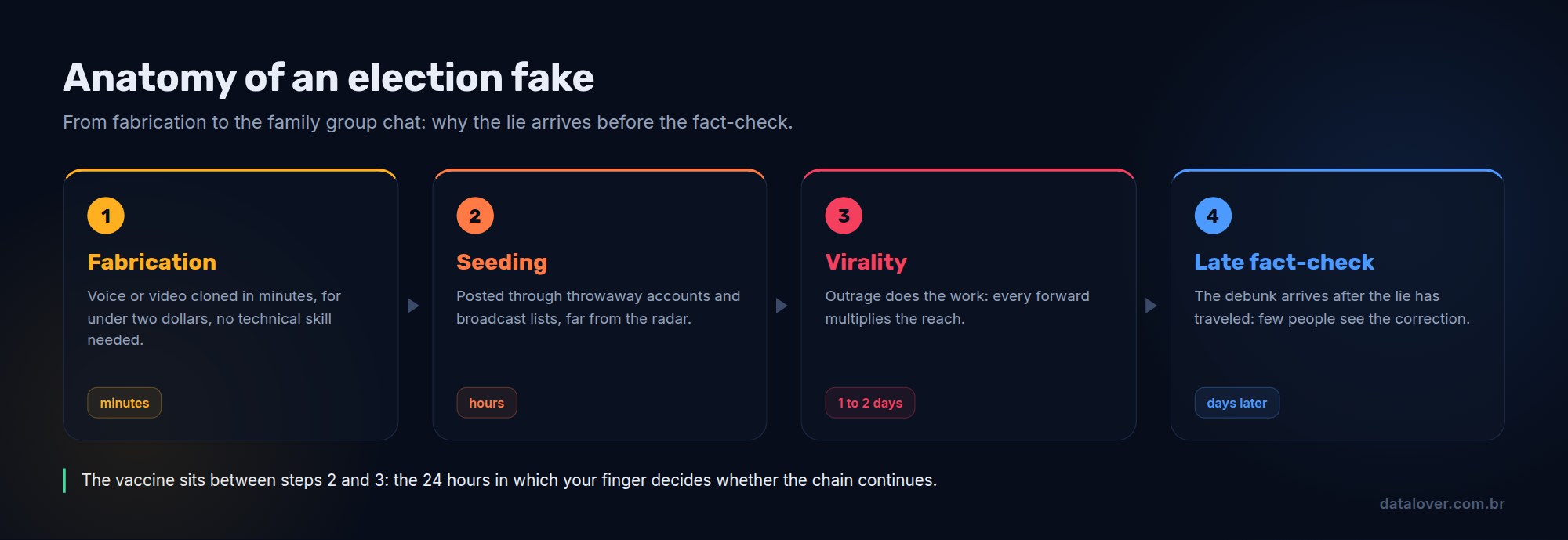
Nobody shares a fake believing it is fake. The engineering is emotional: false content is designed to trigger outrage or confirmation ("I knew it!"), and high emotion switches off the critical filter. An MIT study published in Science (Vosoughi et al., 2018) measured the pattern: lies travel faster and farther than corrections, because corrections are boring and lies are exciting.
And there is the 2026 detail: volume. Fabricating disinformation became so cheap that the strategy is no longer ONE perfect fake, but a flood. The goal is not always to convince you of something; sometimes it is just to leave you unsure of what to believe, which is already a win for whoever plays dirty.
The 4 practical vaccines
- The 24-hour rule. An election bombshell that makes you want to forward it NOW: wait a day. If it is true, the entire press will be covering it tomorrow. If it is a lie, you avoid becoming an accomplice. No true electoral information expires in 24 hours.
- Search before believing. Thirty seconds in a search engine. Did any professional outlet, of any editorial line, publish it? If NO newsroom did, the odds of fabrication are extremely high.
- Official sources exist for this. Questions about voting machines, rules or schedules: the electoral court's official channels answer. Rumors about candidates: their verified channels and fact-checking agencies do this work daily.
- Distrust what confirms too well. The most effective fake says exactly what you wanted to hear about the candidate you already despise. When the "news" fits your side too perfectly, double the checking: you are the target.
What the law says (and it is harsher than you think)
Brazil's electoral courts tightened the rules for AI in TSE Resolution 23,732/2024: campaign content made with AI requires an explicit label; deepfakes against candidates are banned and can cost the beneficiary their registration or mandate, besides constituting a crime; and platforms must take down notified disinformation faster during the electoral period. That "funny" fabricated video of a candidate, mass-forwarded, is not a meme; it is an electoral offense.
AI also plays defense
To close without paranoia: the same technology protects. Fact-checking agencies use AI to track rumors at scale, platforms deploy synthetic-media detection, and content-authenticity labeling standards are advancing fast. The tool is neutral; intention picks the side.
October will be loud. Your vote is yours, your bubble is yours, your candidate is your business. But the finger on the forward button is a public responsibility: every fake that dies on your screen is a lie that never reaches your mother, your uncle, your building's group chat. The 2026 election is also won that way.
Frequently asked questions
Distrust the combo of urgency, scandal and messaging-group origin. Check whether any professional outlet reported it, look at the candidate's official channels and fact-checking agencies, and wait 24 hours before forwarding: true news does not expire in a day.
Yes. Electoral court rules ban deepfakes against candidates, require explicit labels on AI-made campaign content, and violations can cost the beneficiary their registration or mandate, in addition to criminal liability.
Four formats dominate: cloned-voice "leaked" audios, synthetic videos of statements that never happened, fabricated screenshots of headlines and chats, and invented polls with no institute or registration.
Official electoral court channels for rules and voting machines; fact-checking agencies for rumors; and professional press outlets. If no newsroom published it, fabrication is very likely.
Because the content is engineered to trigger emotion (outrage or confirmation of existing beliefs), and high emotion switches off critical thinking. Lies also spread faster than corrections, and floods of cheap fakes create deliberate confusion.
Data and AI executive with 20+ years building technology that moves businesses. Microsoft Certified Trainer, with executive education at MIT Sloan. At Data Lover, he trains professionals and leads enterprise AI projects.
See profile and all articles →