The 5 Things AI Cannot Do for You (That MIT Measured): The EPOCH Map

What is MIT's EPOCH framework?
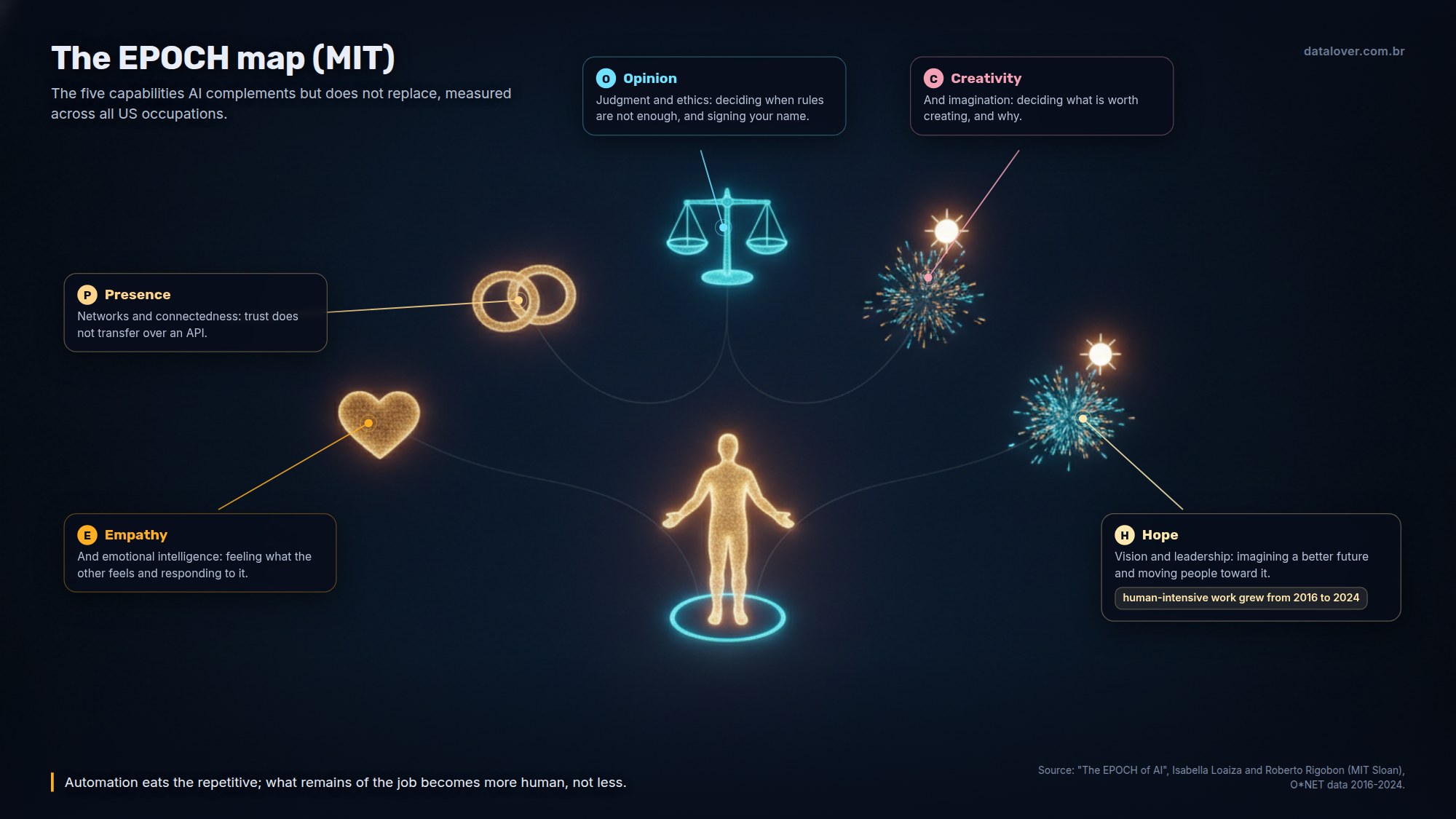
A map created by Isabella Loaiza and Roberto Rigobon (MIT Sloan) of the human capabilities AI complements but does not replace: Empathy and emotional intelligence, Presence, networking and connectedness, Opinion, judgment and ethics, Creativity and imagination, and Hope, vision and leadership. The study measured these capabilities task by task across all US occupations using the O*NET database, from 2016 to 2024.
We spent the last few weeks on this blog talking about what AI takes: tasks, margins, raises. Today the subject is the opposite, and it comes with a ruler and data: what AI does not take. Two MIT Sloan researchers, Isabella Loaiza and Roberto Rigobon, measured across all US occupations the capabilities where humans remain irreplaceable, and found something that contradicts the standard panic: between 2016 and 2024, work that depends on those capabilities increased, not decreased. Their map fits in five letters: EPOCH.
What EPOCH is
In Rigobon's words: "there is a prevalent narrative that robots are coming for the jobs; we thought it was important to ask different questions". Instead of asking "which professions will AI destroy?", the study asked: which human capabilities do machines complement but not replace? The answer, measured task by task in the O*NET database (the largest US occupation catalog), formed five groups:
- E — Empathy and emotional intelligence. Feeling what the other person feels and responding to it. The nurse who senses the fear behind the question; the manager who notices the silence in the meeting.
- P — Presence, networking and connectedness. Being physically present and building real relationships. Trust does not transfer over an API.
- O — Opinion, judgment and ethics. Deciding when the rules are not enough, and signing your name to it. The same "judgment" Sequoia points to as the value that does not commoditize; MIT got there from the opposite direction, by measuring people.
- C — Creativity and imagination. Not the creativity of generating variations (AI does that by the bucket), but of deciding what is worth creating and why.
- H — Hope, vision and leadership. The most beautiful and least discussed: the capacity to imagine a better future and move people toward it. No model has a tomorrow to care about.
What the study found
Three findings, all against the panic:
- Human-intensive work grew. Between 2016 and 2024, both the number of tasks requiring EPOCH capabilities and the frequency with which workers perform them increased. Automation eats the repetitive tasks, and what remains of the job becomes more human, not less.
- New tasks are even more EPOCH. Tasks added to the catalog in 2024 (the work being born right now) show higher levels of these capabilities than older ones. The work of the future is being created exactly where the machine stops.
- Augmenting is different from replacing. The study separates automation (the task moves to the machine) from augmentation (the machine makes you capable of what you could not do before), and shows many occupations benefit more from the latter. As Loaiza puts it: what matters is not the isolated task, but the structure of tasks within a job.
Our reading
Put the three weeks together: the scissors showed that salary migrates to whoever masters the tool; Sequoia showed that margin migrates to judgment; EPOCH shows where humans should invest the energy that is left. And here lives the most common mistake we see: people spending one hundred percent of their effort competing with AI on its own turf (producing faster, writing more, calculating more) and zero developing the ground where it does not enter. The five letters are not consolation for those left behind; they are the notice of what the market will pay dearly for.
One detail the study makes clear and we insist on repeating: EPOCH is not anti-technology. Whoever uses AI to clear the calendar of repetitive tasks is exactly who frees hours for empathy, presence and vision. The right tool does not compete with the five letters; it funds them.
How to use the map in your career
- Audit your week. How many hours do you spend on tasks AI already does (reports, spreadsheets, standard emails) and how many on EPOCH (hard conversations, decisions, client relationships, developing people)? The first list is what you should be delegating to the machine; the second is your compounding edge.
- Pick one letter per quarter. Empathy is trainable (active listening, feedback), presence is trainable (networks, community), judgment is trainable (deciding with explicit criteria and reviewing later), so are creativity and vision. They are muscles, not gifts.
- In reviews and promotions, sell EPOCH with proof. "I led the conversation that kept client X", "I trained two analysts", "I set the direction of project Y". It is the part of your work no model benchmark reaches.
The final irony is a good one: we spent ten years asking what machines can do. MIT's most useful study on AI answers another question: what only people can. And the answer is not shrinking. It is growing, and it has a map.
Frequently asked questions
A map created by Isabella Loaiza and Roberto Rigobon (MIT Sloan) of the human capabilities AI complements but does not replace: Empathy and emotional intelligence, Presence, networking and connectedness, Opinion, judgment and ethics, Creativity and imagination, and Hope, vision and leadership. The study measured these capabilities task by task across all US occupations using the O*NET database, from 2016 to 2024.
That human-intensive work grew between 2016 and 2024: both the number of tasks requiring EPOCH capabilities and the frequency with which they are performed increased. Moreover, tasks newly added to the catalog in 2024 show higher levels of these capabilities than older ones.
Automation is the task moving from the person to the machine. Augmentation is the machine expanding what the person can do. The MIT study shows many occupations benefit more from augmentation, and that what matters is the structure of tasks within a job, not the isolated task.
MIT Sloan's research suggests AI is more likely to complement than replace: repetitive tasks get automated and what remains of the job depends more on human capabilities (empathy, judgment, creativity, vision), which grew over the measured period.
Audit your week (separate hours on tasks AI already does from hours on EPOCH capabilities), train one capability at a time (empathy, presence, judgment, creativity and vision are trainable muscles) and prove those deliveries in reviews and promotions, while using AI to free time from repetitive tasks.
Data and AI executive with 20+ years building technology that moves businesses. Microsoft Certified Trainer, with executive education at MIT Sloan. At Data Lover, he trains professionals and leads enterprise AI projects.
See profile and all articles →