In the AI Era, Working Hard Is No Longer a Differentiator: Here Is What Gets Recognized

Has hard work lost its value in the job market?
No. What changed was the ruler: with AI making execution cheap, visible effort (hours, presence) stopped indicating results. Effort still counts when applied where machines cannot reach: discernment, judgment, review and learning.
There is a phrase everyone has heard in a performance review: "they are such a hard worker". For decades, that was a powerful compliment. Arriving early, leaving late, pulling all-nighters to deliver: visible effort was the currency of professional recognition.
That currency is losing value. Not because effort stopped mattering, but because AI broke the ruler we used to measure it. And whoever misses this shift risks stockpiling a currency the market has stopped accepting.
Why effort used to mean value
Let us be fair to the past: rewarding effort made complete sense. When producing was expensive and slow, hours worked were a good thermometer of how much someone produced. The analyst who spent 8 hours building the spreadsheet delivered more than the one who spent 4. The writer who worked all night produced more pages than the one who stopped at 6 pm.
Effort was an indirect indicator of results. Since measuring results directly was hard, companies measured what they could see: presence, hours, sweat. And it worked reasonably well for a long time.
What AI broke
AI crushed the cost of doing. Tasks that consumed an entire afternoon (summarizing a 50-page report, drafting the first version of a presentation, cross-referencing two spreadsheets, writing a delicate email) now take minutes for those who know how to use the tools.
And here is the point that changes everything: when the cost of doing collapses, the amount of effort stops indicating the amount of results.
Picture two analysts with the same task: consolidating the month's numbers into a report. The first spends 8 hours building everything by hand, cell by cell. The second delivers the same report in 40 minutes using AI for the grunt work, then uses the free afternoon to investigate why the margin dropped, something nobody asked for, but which is worth money.
On the old ruler, the first one is "harder working". On the real ruler, the second delivered twice as much. Which one would you promote?
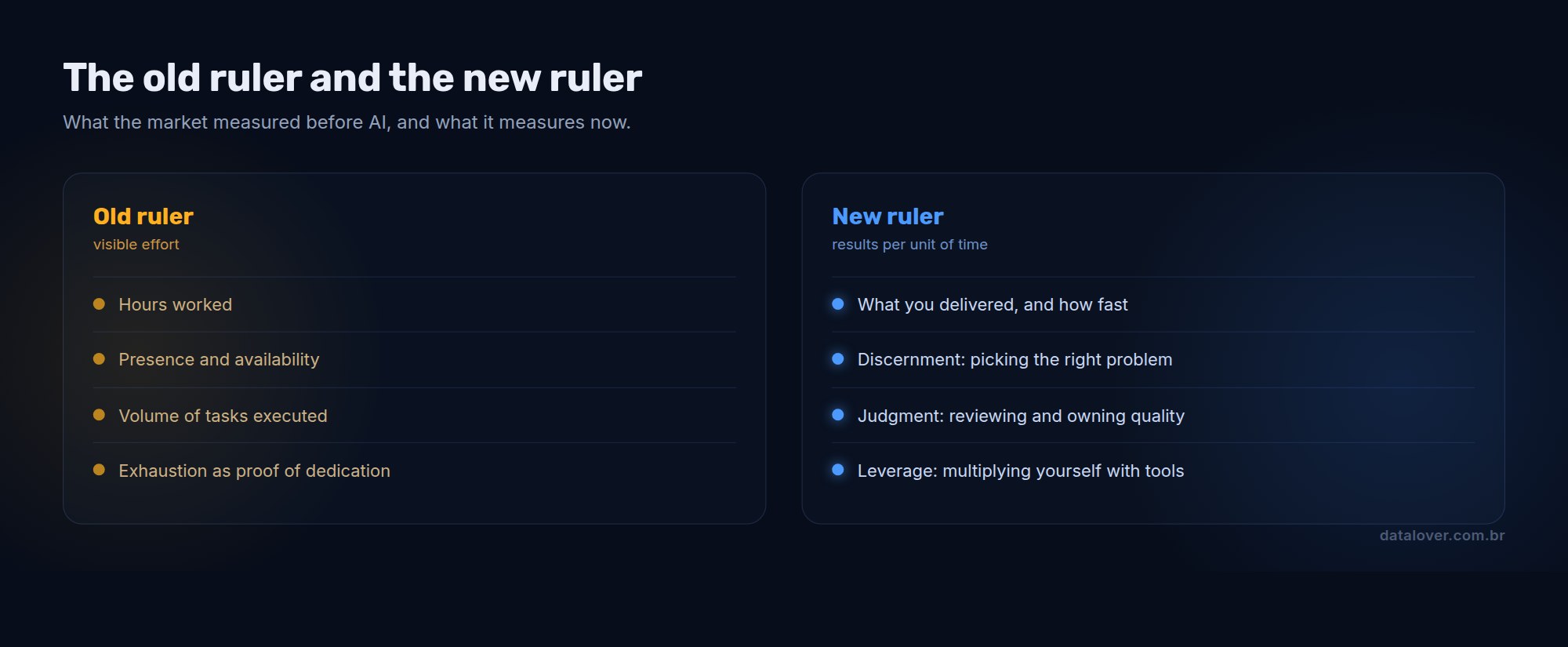
The new ruler: results per unit of time
The market is migrating, late and with some pain, to a more honest ruler: what you deliver, in how much time, at what quality. On this ruler, some skills that used to look secondary become the stars:
- Discernment in choosing the problem: with execution cheap, aiming at the wrong target became proportionally more expensive. Spending 40 minutes solving the right problem beats 8 hours solving the wrong one.
- Judgment to review: AI produces fast, but it produces wrong with confidence. Whoever can evaluate, correct and take responsibility for the final result becomes the quality control the machine does not have.
- Tool leverage: knowing the right tools and commanding them well multiplies delivery capacity. It is the difference between carrying stones and operating the crane.
- Communication: turning a technical result into a business decision remains human work, and it became more valuable because there is more time for it.
What this does NOT mean
Beware of two wrong readings of this thesis.
It is not an apology for laziness. The professional who delivers in 40 minutes and disappears for the rest of the day is wasting the advantage, not using it. The time AI frees up is exactly where the differentiator is born: digging deeper, serving more clients, learning the next tool, anticipating the next problem.
Nor is it the end of effort. Effort still exists, but it changes address. It leaves repetitive execution and moves to where the machine cannot reach: thinking better, deciding better, reviewing better, learning faster. It is a less visible effort (nobody sees you thinking), which is precisely why recognition now requires showing results, not exhaustion.
Signs of those who already got it
You can recognize the new-ruler professional by a few behaviors:
- They talk about results and deadlines, not hours worked ("I delivered X, which generated Y" instead of "I worked until 11 pm").
- Before executing, they ask "why does this matter?" and sometimes discover the task did not need to exist.
- They keep an arsenal of tools and test a new one every week, without waiting for formal training.
- They use the freed-up time for higher-value work, and make it visible to the team and the manager.
- They sign what AI produces: they review, correct and take responsibility for the final result.
How to make the transition, in practice
If you recognized yourself in the old ruler, here is a straightforward plan:
- Week 1: audit your time. Write down where your hours go. Flag everything that is repetitive execution: reports, formatting, summaries, standard emails, spreadsheets.
- Weeks 2 and 3: attack the biggest blocks with AI. Take the two most time-consuming tasks and learn to do them with tool support. Accept that it will be slower at first; that is investment.
- Week 4: reinvest the freed-up time. Consciously choose where to apply the hours you gained: a problem nobody is looking at, a client who deserves more attention, a new skill.
- Always: change your vocabulary. In conversations with your manager, replace effort reports with result reports. You train your own ruler and, as a bonus, theirs.
A note for those who lead
If you manage people, this shift charges a price from your ruler too. Evaluating by presence and hours was convenient, but it now rewards exactly the wrong behavior: whoever works slowly by hand looks more dedicated than whoever delivers triple with leverage.
Start measuring what matters: deliverables, quality, impact. And watch out for the classic trap: if every productivity gain just becomes "more tasks of the same kind", your best people learn to hide their efficiency. The prize for delivering faster must be more interesting work, not disguised punishment.
The effort the market used to recognize was the hand's. What it now recognizes is the head's: discernment, judgment and the intelligence to make machines work in your favor. The good news is that this can be learned. And whoever learns it now, while most people still measure sweat, gets there first.
Frequently asked questions
No. What changed was the ruler: with AI making execution cheap, visible effort (hours, presence) stopped indicating results. Effort still counts when applied where machines cannot reach: discernment, judgment, review and learning.
Because tasks that took hours now take minutes for those who master the tools. When two people deliver the same thing in very different times, measuring hours loses meaning; what counts is results per unit of time.
Choosing the right problem, reviewing and owning the quality of what AI produces, mastering tools that multiply delivery, and communicating results so they become decisions. Head skills, not hour volume.
Replace effort reports with result reports: what you delivered, in how much time, with what impact. Make visible how you used AI-freed time for higher-value work, like investigating problems or serving clients better.
By measuring deliverables, quality and impact instead of presence and hours. And by rewarding productivity gains with more interesting work, not more repetitive tasks, otherwise the team learns to hide efficiency.
Data and AI executive with 20+ years building technology that moves businesses. Microsoft Certified Trainer, with executive education at MIT Sloan. At Data Lover, he trains professionals and leads enterprise AI projects.
See profile and all articles →