How Much Energy (and Water) Does One ChatGPT Question Cost?
How much energy does one ChatGPT question use?
The most cited public estimates put a typical text question between 0.3 and 3 watt-hours, depending on the model and answer length. That is up to 10 times a traditional web search, but less than minutes of video streaming.
Every time you send a question to an AI, somewhere in the world a building full of computers warms up a little, and a cooling system works to bring the temperature back down. Multiply that by billions of questions a day and the bill gets serious: AI data centers already compete for power and water with entire cities.
But how much does ONE question cost, exactly? The answer is smaller than the alarmists claim and bigger than the companies would like. The numbers are worth understanding before forming an opinion.
The cost of one question
The most cited public estimates, such as those from Epoch AI, a Google study on Gemini's consumption and figures released by OpenAI itself, put a typical text question at around 0.3 to 3 watt-hours of energy, depending on the model and the answer's length, and somewhere between a few milliliters and a tablespoon of water for cooling. Mandatory honesty: these are estimates with wide margins, because companies disclose little and methods vary.
To give the numbers some body:
- One AI question ≈ up to 10 times a traditional web search.
- A hundred questions ≈ less energy than one hour of HD video streaming.
- A full day of heavy use ≈ far less than a 10-minute hot shower.
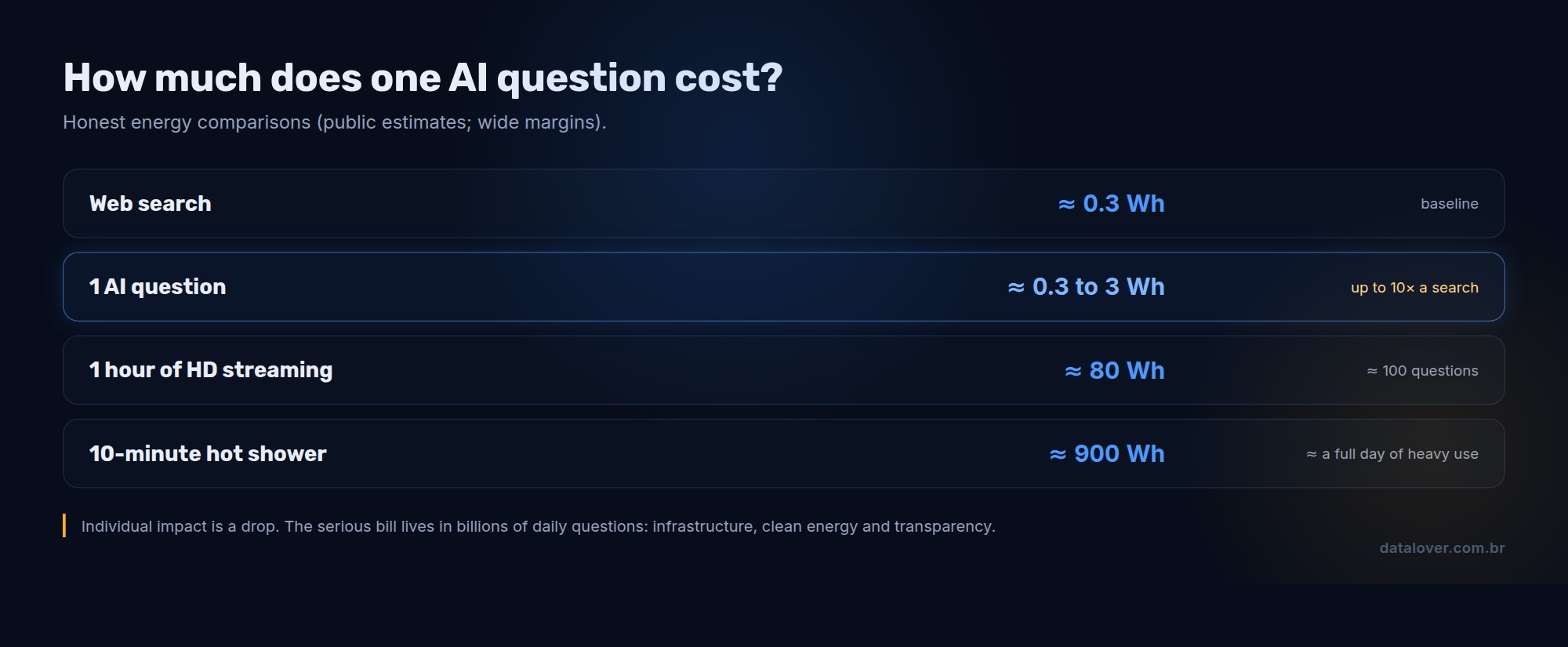
In other words: at the individual level, your AI conversation is a drop. The problem is not the drop.
The problem is the ocean of drops
Billions of questions a day, plus image and video generation (much heavier than text), plus the training of new models, turn drops into rivers. Data centers already account for a relevant and growing share of the world's electricity use, and projections point upward year after year. In some regions, new data centers compete with residents for grid capacity and water, and local energy bills feel it.
And there is a split almost nobody explains:
- Training a large model is a rare, energy-hungry event, like building a factory.
- Using the model (inference) is cheap per unit but happens billions of times a day. Today, accumulated use dominates the bill.
Why water entered the story
Powerful computers run hot, and cooling with air is energy-expensive. Many data centers use evaporative systems: water evaporates to carry the heat away, and part of it never comes back. Hence the headlines about AI "drinking" millions of liters. The knot: data centers tend to be built where energy is cheap, and those places are sometimes precisely the driest.
What companies are actually doing
- Ever more efficient chips: each generation delivers more answers per watt; per-question efficiency keeps falling fast.
- Right-sized models: using a small model for a small task costs a fraction; not every question needs the giant model.
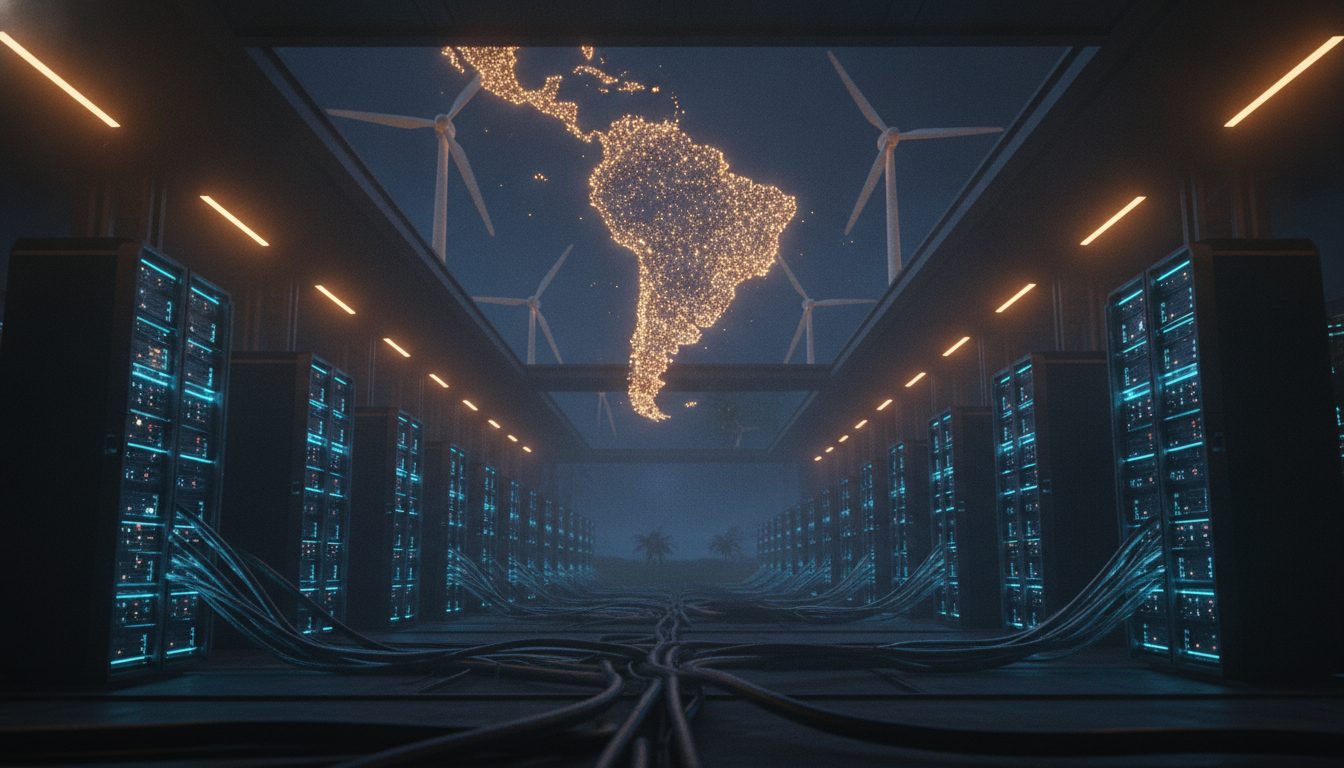
- Clean energy and location: renewable contracts, nuclear bets, and data centers in cold climates or near hydropower (Brazil, with its clean grid, entered this dispute's map).
- Better cooling: closed-loop liquid cooling reducing evaporation.
And here lives the honest dilemma, known as Jevons paradox: per-question efficiency falls, but total use explodes faster. Getting cheaper makes everyone use more.
Should you feel guilty?
Individually, no. Cutting your AI questions has the climate impact of skipping a straw: symbolic gesture, negligible effect. The decisions that move the needle are infrastructure decisions: where data centers are built, what energy powers them, what transparency they publish.
What makes sense at your level: use the right-sized tool for the problem (not everything needs the big model), demand transparency from AI vendors, and, if your company buys cloud and AI at scale, put the energy question in the contract, because there the numbers are big.
The right question
"Can I use AI without destroying the planet?" is the wrong question, and the answer is yes. The right one is collective: what will we demand from the infrastructure being built right now? Clean energy, responsible water use and open numbers are not technical details; they are the price of admission for a technology that came to stay big. Whoever pays the power bill has the right to ask that question out loud.
Frequently asked questions
The most cited public estimates put a typical text question between 0.3 and 3 watt-hours, depending on the model and answer length. That is up to 10 times a traditional web search, but less than minutes of video streaming.
Because of data center cooling: many use evaporative systems where water evaporates to carry heat away from servers, and part of it never returns. A typical question costs from a few milliliters up to a tablespoon of water.
Training a large model is a rare, extremely energy-hungry event, but daily use (inference), multiplied by billions of questions, dominates the accumulated bill today.
Individual impact is negligible, comparable to symbolic gestures like skipping straws. The decisions that matter are infrastructure ones: data center location, energy source, efficiency and transparency. Personally, using smaller models for simple tasks helps.
More efficient chips each generation, smaller models for simple tasks, renewable and nuclear energy contracts, data centers in cold regions or clean grids, and closed-loop liquid cooling that reduces water evaporation.
Data and AI executive with 20+ years building technology that moves businesses. Microsoft Certified Trainer, with executive education at MIT Sloan. At Data Lover, he trains professionals and leads enterprise AI projects.
See profile and all articles →