Speed Is the New IQ: Why AIs Now Fight Over Milliseconds

Why did speed become a priority in the AI race?
Because slowness was the invisible brake: entire categories of use, like voice conversation, simultaneous translation and multi-step agents, only work with near-instant responses. Recent announcements reach 750 tokens per second, up to 14 times faster than the models' normal pace.
For three years, the AI race was about intelligence: which model writes better, reasons deeper, errs less. That race is not over, but another one appeared, and it is about time. OpenAI just announced a response layer up to 14 times faster, around 750 tokens per second; competitors measure success in milliseconds. It sounds like an engineering detail until you understand what speed unlocks: an AI that answers instantly is not just more pleasant. It fits in places the slow one never could.
Translating the announcement for normal people
"750 tokens per second" means, in practice, the whole answer appearing before you finish blinking. A full page of text in about two seconds. The difference between watching the AI "type" and receiving the answer ready, as if it already knew.
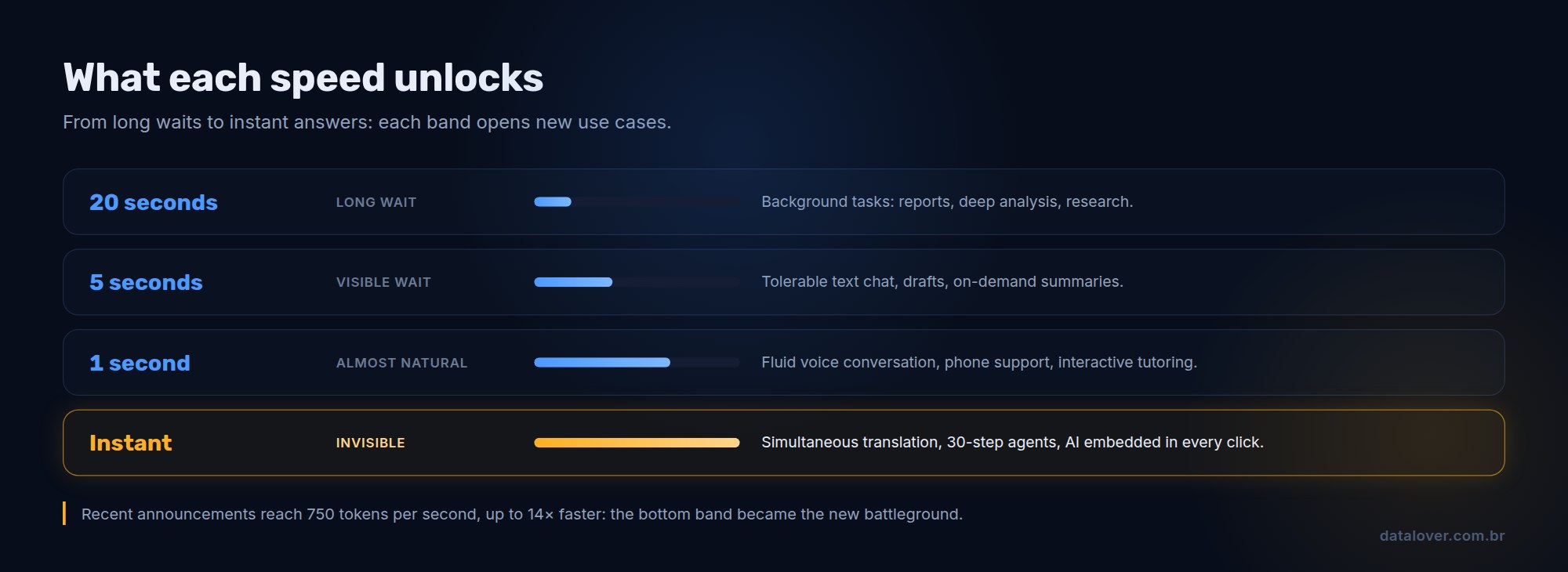
Why did this become the industry's obsession now? Because slowness was AI's invisible brake. We got used to waiting 10 or 20 seconds for a good answer, but getting used to it is not the same as it working: entire categories of use die while waiting.
What speed unlocks
- Real voice conversation. Human dialogue has rhythm: more than a second of silence and the conversation dies. A voice AI that takes 5 seconds is an answering machine; with millisecond responses, it becomes an interlocutor. Every AI phone support product depends on this.
- Simultaneous translation. Translating speech in real time requires processing and returning almost together with the speaker. It is latency, not intelligence, that separates the sci-fi pocket translator from the feature now arriving on phones.
- Agents that actually work. An agent runs dozens of chained steps: think, query, decide, repeat. If each step takes 10 seconds, a 30-step task takes 5 minutes; with half-second steps, 15 seconds. Speed multiplies what fits inside an acceptable wait.
- Invisible AI, embedded everywhere. Autocomplete, corrections, suggestions, classification on every click: features that only exist if the answer arrives before you notice you asked.
The hidden trade-off (missing from the announcements)
Speed has a price, and it is not always money. Much of the gain comes from running smaller models or distilled versions of the big one, and smaller models think less deeply. The right question is not "which AI is fastest?" but "does this task need depth or agility?"
- Drafting the contract, analyzing the complex spreadsheet, reviewing the important text: patience pays, call the deep model.
- Answering the phone, autocompleting, classifying, handling the trivial: instant wins, call the fast one.
The organizing analogy: the deep model is the specialist you consult and wait for; the fast one is the clerk who solves it on the spot. AI-mature companies do not pick one; they staff the counter with both and route each task to the right profile.
What changes for you
As a user: notice the response time of your tools; it explains what each is for. And distrust the marketing: "we have the fastest model" without saying what it delivers is like selling the fastest car without mentioning how many seats it has.
As a company: latency became a contract criterion. If your use case is voice, support or multi-step agents, ask the vendor for response-time numbers BEFORE the token price. A voice bot with a 4-second delay is not a worse bot; it is a product that does not exist.
Intelligence draws headlines; speed changes habits. The AI you will use most a year from now is probably not the one that writes the prettiest essay, but the one that answers before you notice you waited. In the history of technology, the winner was rarely the most powerful. It was the one always at hand.
Frequently asked questions
Because slowness was the invisible brake: entire categories of use, like voice conversation, simultaneous translation and multi-step agents, only work with near-instant responses. Recent announcements reach 750 tokens per second, up to 14 times faster than the models' normal pace.
It measures how fast the AI generates text. At 750 tokens per second, a full page comes out in about two seconds: the answer appears ready instead of being "typed" on screen.
No. Part of the speed comes from smaller models that think less deeply. Complex tasks (contracts, analyses, important texts) call for the deep model; flow tasks (voice, triage, autocomplete) call for the fast one. Mature companies use both and route each task.
Voice conversation with human rhythm (sub-second responses), simultaneous speech translation, agents executing dozens of steps in seconds, and embedded features that respond on every click, like instant suggestions and classification.
As a contract criterion: for voice, support and agent use cases, ask for response-time numbers before the price. A voice assistant with a 4-second delay is not worse; it is unviable. Latency defines whether the product exists.
Data and AI executive with 20+ years building technology that moves businesses. Microsoft Certified Trainer, with executive education at MIT Sloan. At Data Lover, he trains professionals and leads enterprise AI projects.
See profile and all articles →