Stop Giving Your AI Orders: Teach It Once. What Skills Are and Why They Change the Game.

What is an AI skill?
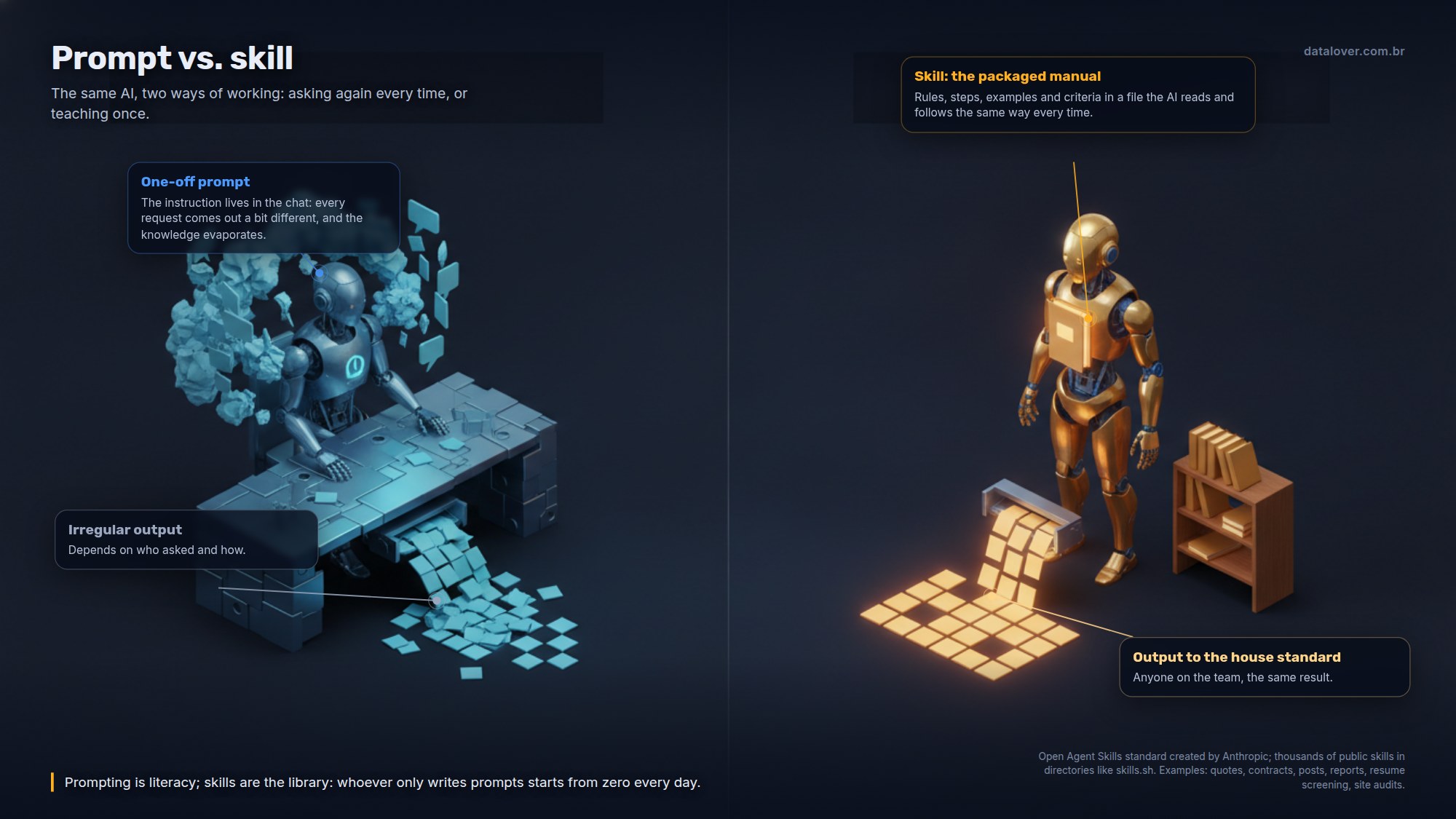
A process manual packaged in a format AI knows how to read and follow: a folder with instructions (rules, step by step, examples, quality criteria) and support files. Instead of repeating prompts, you teach the process once and the AI runs it to the same standard every time. The format was created by Anthropic and became an open standard used by many tools.
Everyone who uses AI at work knows the scene: you polished a perfect prompt, the result came out impeccable, and a week later you are rewriting it from memory, and it comes out different. The knowledge was trapped in a conversation that died. Skills solve exactly that, and are, in our view, the most useful idea of the year for anyone who wants to use AI in an organized way: instead of giving orders every time, you teach once, and the AI runs it the same way every time.
What a skill is, without jargon
A skill is a how-we-do-it manual, packaged in a format AI knows how to read and follow. Technically it is a folder with an instruction file (the rules, the step by step, the examples, the quality criteria) and, if needed, support files and scripts. The standard was created by Anthropic for its agents and became an open format that today works across a dozen tools; there is even a public directory with thousands of ready-made skills installable with one command.
A helpful analogy: a prompt is giving verbal instructions to a new intern every morning; a skill is the training manual that makes any intern deliver to the house standard from day one. The difference is not sophistication, it is institutional memory: knowledge leaves your head (or the chat) and becomes a company asset.
What you can build with skills (practical examples)
To leave the abstract, six skills any company can assemble, each from a manual that probably already exists informally in-house:
- Sales quotes. Pricing rules, house tone, what never to promise, two examples of a good proposal. Every quote request comes out to standard, in minutes.
- Standard contract review. The mandatory clauses, the forbidden ones, the attention points per contract type. The AI reviews and returns a checklist of what strayed from the rule.
- Brand posts and content. Tone of voice, approved formats, banned words, examples of what has worked. Anyone on the team publishes with the same voice.
- Weekly report. Where the numbers come from, which indicators go in, in what order, what triggers an alert. Monday morning the draft is ready, always the same.
- Resume screening. Explicit criteria for the role, what eliminates, what stands out, and the requirement to justify every decision in writing (important: screening suggests, a human decides).
- Site audit. A full checklist of SEO and presence in AI search engines that runs at once and returns a prioritized fix list.
The pattern repeats: wherever there is a "right way of doing it" that today lives in someone's head, a skill fits, and that "employee" does not forget, does not improvise off-standard and does not deliver differently on a Monday.
Why this organizes a company (not just speeds it up)
- Standards become code. "How we answer clients", "our quote format", "the tone of our proposals": today all of that lives in two people's heads. As a skill, it becomes a versioned, reviewable, improvable file that AI applies equally for everyone.
- Composition. Skills combine: the proposal skill calls the tone-of-voice skill, which respects the visual identity skill. It is building processes out of parts that fit together.
- People training too. A good side effect: writing the skill forces the company to make the process explicit. Many companies discover they had no standard at all, only habits.
- Less dependence on "whoever knows how to ask". The premium for AI skills still exists, but a skill democratizes the result: the junior with the right skill delivers to the standard of the senior who wrote it.
How to create your company's first skill
- Pick a repeating process that today depends on one person: answering quotes, reviewing standard contracts, writing posts, building the weekly report.
- Write the manual as if for a new employee: goal, step by step, 2 or 3 examples of good output, the mistakes it must never make, and how to know it is good.
- Test and tighten. Run it on real cases, compare with what your best professional would do, and fix the manual (not the request) on every difference.
- Version it. A skill improves with use, like any process. The difference is the improvement now stays recorded instead of evaporating in the next chat.
Prompting was literacy; skills are the library. Whoever only writes prompts starts from zero every day. Whoever writes skills accumulates, and accumulating is what separates using AI from building something with it.
Frequently asked questions
A process manual packaged in a format AI knows how to read and follow: a folder with instructions (rules, step by step, examples, quality criteria) and support files. Instead of repeating prompts, you teach the process once and the AI runs it to the same standard every time. The format was created by Anthropic and became an open standard used by many tools.
A prompt is verbal instruction: it works for that chat and gets lost. A skill is the training manual: it stays recorded, is versionable and applies the same standard every time. The analogy: a prompt is explaining the task to the intern every morning; a skill is the manual that makes any intern deliver to the house standard from day one.
Not for most cases. A skill is essentially a well-written instruction document (goal, steps, examples, forbidden mistakes, quality criteria). Scripts and automations are optional, for advanced skills. If you can write a training manual, you can write a skill.
Public directories such as skills.sh list thousands of skills installable with one command, covering everything from SEO/GEO to infographic creation and text review. You can also adapt an existing skill to your context: translate the rules, swap the examples for your own and adjust the quality criteria.
Pick a repetitive process that depends on one person (quotes, standard contracts, reports), write the manual as if for a new employee, test it on real cases against your best professional, fix the manual on every difference and version it. Knowledge leaves people's heads and becomes a company asset.
Data and AI executive with 20+ years building technology that moves businesses. Microsoft Certified Trainer, with executive education at MIT Sloan. At Data Lover, he trains professionals and leads enterprise AI projects.
See profile and all articles →