SaaSpocalypse: Why Wall Street Stopped Paying Up for Software (and What Changes for You)

What is the SaaSpocalypse?
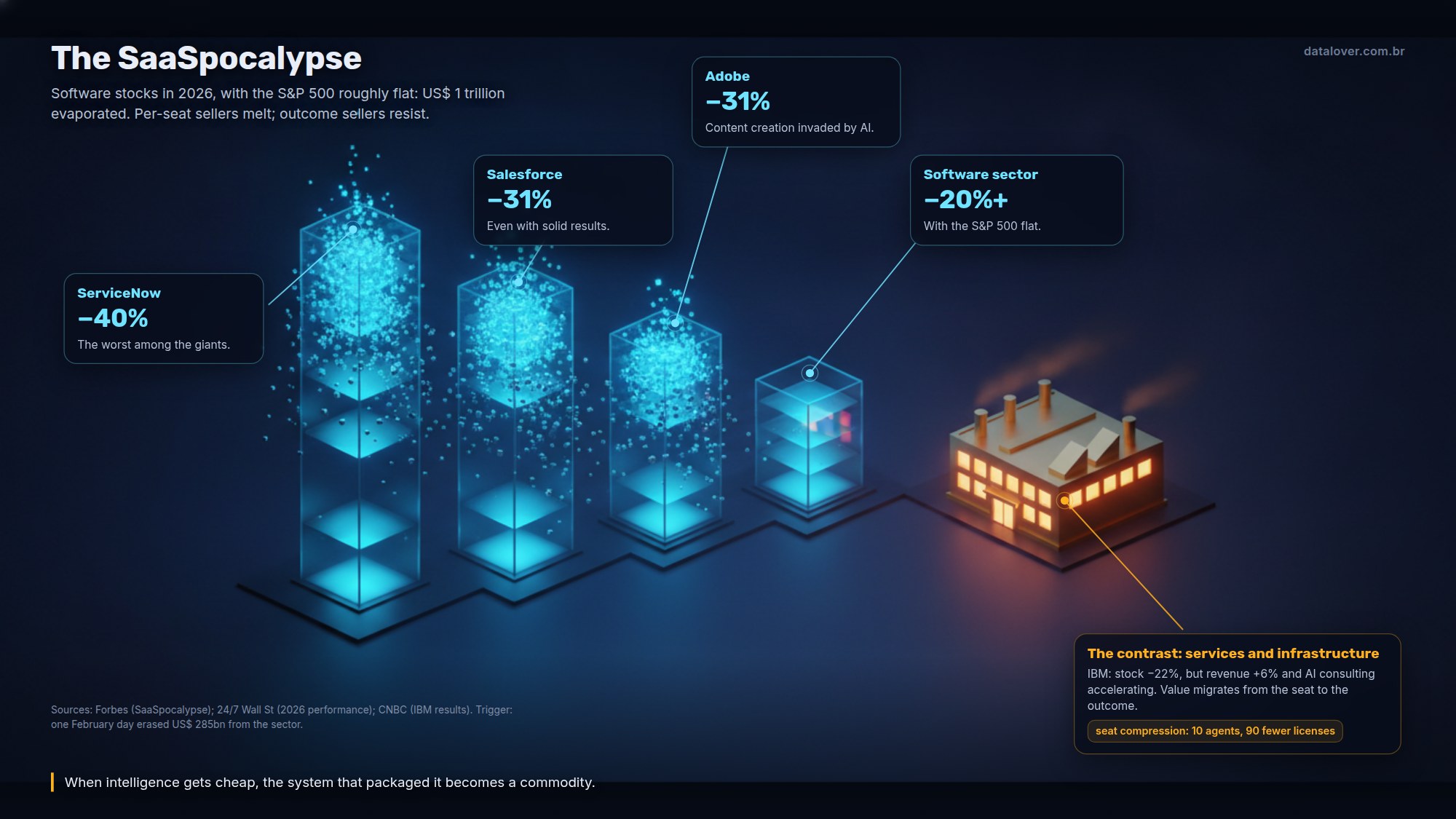
The nickname traders gave the 2026 software stock crash: the sector lost more than 20% (about US$ 1 trillion in value) while the S&P 500 stayed flat. The symbolic trigger was a February day when the announcement of an AI legal-automation tool erased about US$ 285 billion from software companies in a single session.
While the US market ended the last several months roughly flat, an entire sector melted quietly: software stocks lost more than 20% in 2026, about US$ 1 trillion in market value. Traders gave it a name, and the name says it all: SaaSpocalypse. The symbolic trigger was a single day in February, when the announcement of an AI legal-automation tool erased about US$ 285 billion of software market value in one session. The market understood that day what this article explains today: when intelligence gets cheap, the system that packaged it becomes a commodity.
The numbers, company by company
- ServiceNow: −40% for the year, the worst among the giants of enterprise software.
- Salesforce: −31%, even while delivering solid operating results. The market is not punishing the present; it is repricing the future.
- Adobe: −31%, with content creation being the territory most invaded by generative AI.
- The sector: −20%+ with the S&P 500 flat over the same period: not a general crisis, but surgery on one specific sector.
- The contrast that teaches: IBM. The stock also suffered (about −22%), but the business tells another story: revenue growing 6%, earnings per share up 19% and AI consulting accelerating. Those selling services, integration and infrastructure are riding the wave; those selling per-seat licenses are being run over by it.
The mechanism: seat compression
The business model that sustained twenty years of SaaS is simple: charge per user, per month. A hundred sales reps, a hundred CRM licenses. AI breaks that arithmetic from two sides at once:
- Fewer seats. If AI agents do the operational work of dozens of people, the client company does not only cut people; it cuts licenses. Ten agents doing the work of a hundred reps means ninety seats nobody renews.
- Fewer upgrades. Much of SaaS growth came from selling new modules. Now the new functionality is born on the AI model's side, not the system's: the generic assistant writes the report, the analysis and the draft that used to justify the premium module.
For readers following along, this is the second half of a story we have told: Sequoia's thesis showed software swallowing services; now the market prices AI swallowing software itself. The whole chain slides one notch: services become software, software becomes commodity, and value climbs to where the commodity cannot reach: proprietary data, distribution, trust and the judgment of whoever decides.
How companies are reacting
- Changing the price. The leaders are racing to charge per use and per outcome (per resolved conversation, per closed case) instead of per seat. It is admitting the old model dies while trying to control the funeral.
- Embedding the model. If new functionality is born from AI, the answer is putting frontier AI inside the product, and that is exactly the story of the year's biggest partnership, which we cover here on Friday.
- Down to the data, up to the service. Whoever holds the customer's data (history, context, integrations) holds what AI needs to work; whoever has consulting delivers the assembled outcome. Both ends resist; the middle, the generic license, is what melts.
What changes for you
If you buy software: leverage switched sides. Renegotiate per-seat contracts, avoid long lock-ins on tools AI can replace, and ask every vendor for their usage- or outcome-based pricing plan. If they do not have one, today's discount is tomorrow's abandonment notice.
If you sell software or digital services: the question is not whether your per-seat (or per-hour) price survives, but how long it has. The defensive moves are the same as the giants', at smaller scale: price the outcome, embed real AI in the product and accumulate the data only you have. A commodity is what anyone delivers identically; the antidote is owning something nobody else has.
Wall Street did not stop believing in technology; it stopped paying up for intermediating intelligence that became cheap. It is the same pair of scissors from recent weeks, now cutting the balance sheets of companies worth tens of billions. And, as always, it warns the publicly listed first, but it cuts everyone.
Frequently asked questions
The nickname traders gave the 2026 software stock crash: the sector lost more than 20% (about US$ 1 trillion in value) while the S&P 500 stayed flat. The symbolic trigger was a February day when the announcement of an AI legal-automation tool erased about US$ 285 billion from software companies in a single session.
Among the giants: ServiceNow about -40% for the year (the worst), Salesforce -31%, Adobe -31%, with the whole sector losing more than 20% while the S&P 500 stayed roughly flat. IBM fell about 22%, but with revenue growing 6% and AI consulting accelerating, the contrast that shows where value is migrating.
The central mechanism of the repricing: SaaS charges per user per month, and AI agents reduce the number of users needed. If ten agents do the operational work of a hundred people, ninety licenses stop being renewed. In addition, new functionality is born on the AI model side rather than the system side, weakening premium module sales.
Three main moves: replacing per-seat pricing with usage- or outcome-based pricing (per resolved conversation, per closed case); embedding frontier AI models inside the product; and reinforcing the resilient ends, proprietary customer data and services that deliver the assembled outcome.
Negotiating leverage switched sides: renegotiate per-seat contracts, avoid long lock-ins on tools AI can replace and demand a usage- or outcome-based pricing plan from vendors. A vendor without one tends to be cheaper today and abandoned tomorrow.
Data and AI executive with 20+ years building technology that moves businesses. Microsoft Certified Trainer, with executive education at MIT Sloan. At Data Lover, he trains professionals and leads enterprise AI projects.
See profile and all articles →

