Your Services Firm Is Worth 6 for Every 1 of Software. AI Came for That Difference.

What does Sequoia's "Services: The New Software" thesis say?
That AI is turning services into software: instead of selling the tool the professional uses, companies start selling the finished outcome (closed books, issued policy, reviewed contract). Since the world spends $6 on services for every $1 on software, Sequoia predicts the next $1 trillion company will be "software disguised as a services firm".
For every dollar the world spends on software, it spends six on services: accountants, brokers, lawyers, consultants, recruiters. That ratio was always seen as software's natural limit: machines do not sign audits, negotiate claims or interview candidates. Sequoia Capital, in the essay "Services: The New Software" (Julien Bek, March 2026), says that limit just fell, and sums up the bet in one line: the next $1 trillion company will be a software company disguised as a services firm. If you make a living selling services, this article is about your market.
The thesis, translated
Traditional software sold tools: the system the accountant uses. AI makes it possible to sell the outcome: the finished books. When that happens, the money changing hands stops being the tools budget (small) and becomes the work budget (six times larger). Sequoia lists the markets in the crosshairs, in annual spend: management consulting ($300-400bn), recruiting ($200bn+), supply chain ($200bn+), insurance brokerage ($140-200bn), accounting and audit ($50-80bn), healthcare revenue cycle ($50-80bn), tax ($30-35bn), transactional legal ($20-25bn).
And it describes the transition in two stages. First came copilots: AI that helps the professional (lawyers use Harvey, bankers use Rogo). Now come autopilots: AI that delivers the outcome without the professional in the middle: NDAs reviewed end to end, policies issued, medical codes posted, taxes filed. The copilot sells productivity; the autopilot sells finished work, at a fraction of the human service's price.
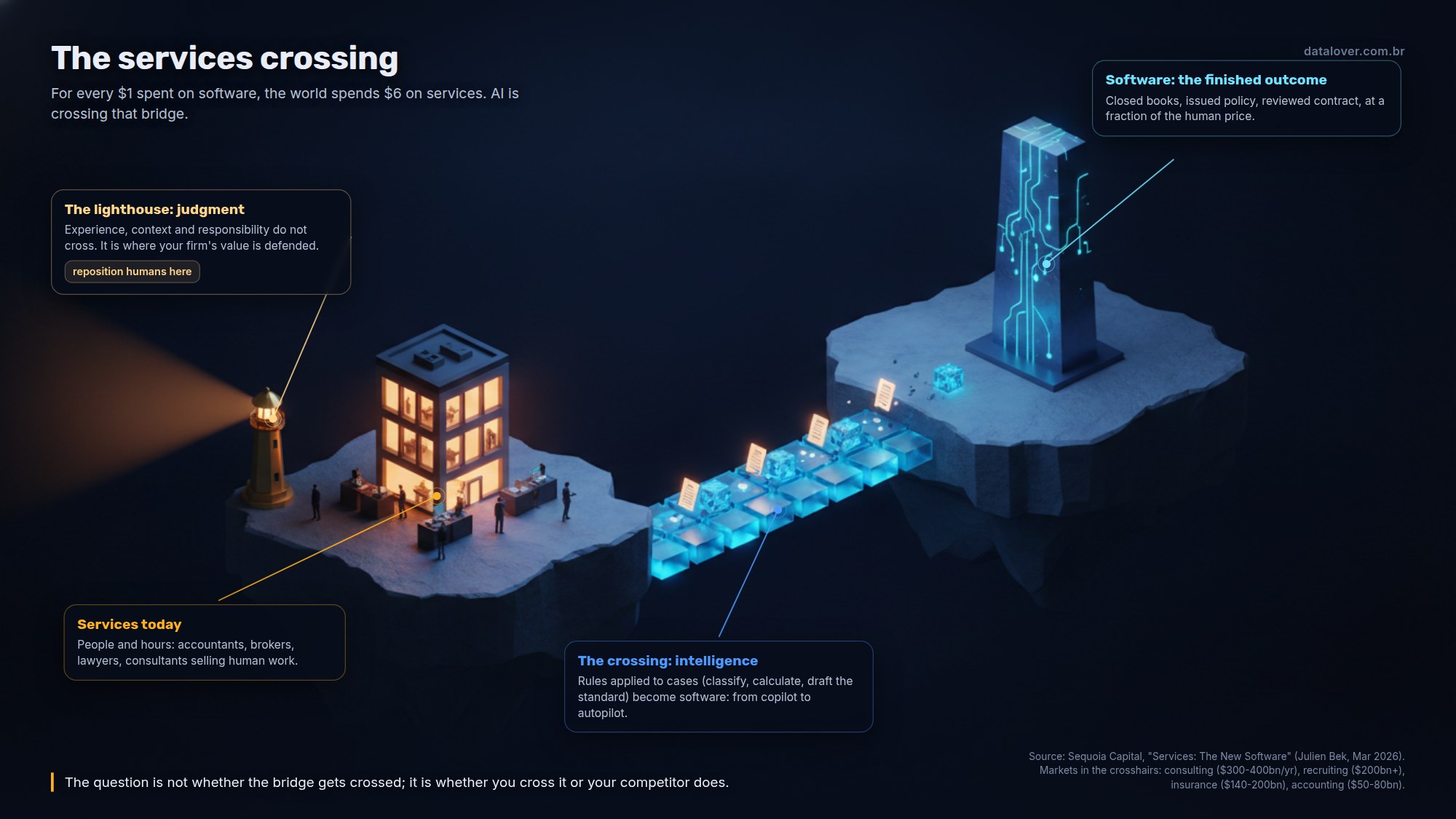
The line between what becomes software and what does not
The essay's most useful concept splits service work into two raw materials:
- Intelligence: applying complex rules to concrete cases. Classifying, calculating, drafting the standard, checking compliance. Hard for a human to learn, and exactly what AI models do better every six months. Everything that is pure intelligence is on its way to becoming software, and cheap software: it commoditizes.
- Judgment: experience, taste, reading context, responsibility. Deciding when the rules are not enough, owning the risk of the decision, looking the client in the eye. AI does not deliver that, and that is where value migrates.
If that split sounds familiar to our readers, it is the market version of the scissors we showed last week: what is executable commoditizes and its price falls; what is judgment becomes scarce and its price rises. There it was the professional's salary; here it is the whole firm's margin.
What to do if you sell services
- Inventory your delivery. Take your service and split it honestly: how many hours are "intelligence" (standardizable, repeatable, rule-applying) and how many are "judgment" (decisions, relationships, responsibility)? The first part's price will collapse, with or without you.
- Automate your own intelligence before someone else does. The margin AI eats in your process can become yours (lower price, higher volume) or your competitor's. The essay notes that entrants start where outsourcing already exists, precisely because those clients already buy outcomes instead of people.
- Reposition humans in judgment. The accountant becomes a decision advisor, the broker a risk manager, the recruiter a hiring consultant. The profession's name stays; its center of gravity moves.
- Keep your data. The long-term defense, per Sequoia itself, is accumulating proprietary data on what good judgment looks like in your niche. Every solved case is training data only you have.
The other side
Two honest caveats. First: the thesis comes from a fund that invests in the companies that confirm it; the incentive to overstate exists, and regulated markets (audit, legal, healthcare) have barriers that do not fall to a benchmark. Second: an autopilot that fails in critical services creates real liability, and legal responsibility still needs a human name at the bottom. The transition will be slowest exactly where mistakes are expensive, which is where fees are highest.
But the direction is one. For twenty years, services firms looked at software as a cost line. From now on, software looks at services firms as a market. The question is not whether the bridge gets crossed; it is whether you cross it or your competitor does, and what you build on the side that does not cross.
Frequently asked questions
That AI is turning services into software: instead of selling the tool the professional uses, companies start selling the finished outcome (closed books, issued policy, reviewed contract). Since the world spends $6 on services for every $1 on software, Sequoia predicts the next $1 trillion company will be "software disguised as a services firm".
The essay lists, in annual spend: management consulting ($300-400bn), recruiting ($200bn+), supply chain ($200bn+), insurance brokerage ($140-200bn), accounting and audit ($50-80bn), healthcare revenue cycle ($50-80bn), tax ($30-35bn) and transactional legal ($20-25bn).
A copilot is AI that helps the professional produce more (the tool is still sold to whoever provides the service). An autopilot is AI that delivers the outcome without the professional in the middle, at a fraction of the human price. Sequoia's thesis is that value migrates from copilots to autopilots as models improve.
Intelligence is applying complex rules to concrete cases (classifying, calculating, drafting standards): what AI does increasingly well and tends to commoditize. Judgment is experience, context reading and responsibility for decisions: what AI does not deliver and where value migrates. A services firm's defense is repositioning its people in judgment.
Four moves: inventory the delivery, separating hours of intelligence from hours of judgment; automate the standardizable part before a competitor does; reposition professionals in judgment roles (advisor, risk manager); and accumulate proprietary data on what good judgment looks like in the niche.
Data and AI executive with 20+ years building technology that moves businesses. Microsoft Certified Trainer, with executive education at MIT Sloan. At Data Lover, he trains professionals and leads enterprise AI projects.
See profile and all articles →